Saturday, October 16, 2004

The Maine Man

This week, I received from Reed Altemus yet another stylish neo-fluxus envelope. His mailings are among the most precise and quietly beautiful that I receive.

The envelope is a larger one in his usual tan (not the common orange) and it is decorated with a few rubberstampings in brown: an INTERNATIONAL POSTAL ART STAR pseudo-cancellation (complete with a hammer and sickle), a Post Flux Flux Post crossroads stamping, and a quizzical stamping of a strangely mammalian beetle hunkered down, staring at us, and with its rearend and wings pointing up into the air.


Reed Altemus, [October's Envelope] (Oct 2004)

This time, the contents of the envelope are simple:

A thermoprinted card (with raised lettering): EVERYTHING THAT IS PRINTED IS GOOD (Dieter Roth)

"Another Postal Surrealist Freakout Poem" with a weirdly indistinct cover I quite like that includes bits of an advertisement for "The world's most / Comfortable Chair."
un violon d'ingres

Dutch Puns and Visual Poetry

I think Qpidoremix, a mailartist from the Netherlands, posted this mailing to me on 6 Oct 2004, since the only numeral I can interpret in the postmark is a "6."

Inside the envelope is a sheet of paper, with a letter on one side, covered with photographs, and laminated into one single piece. (As an archivist, I must point out that we do not support lamination as a preservation method. Encapsulation, interleaving a sheet of paper between two sheets of inert plastic, is the allowable alternative. As a mailartist, I must point out that I realize that preservation is not the main issue here; presenting a unique art experience is!)

Qpidoremix's letter discusses his Dutch poetry, which he calls "BarddraB" ("bard" meaning "bard," and "drab" meaning--instead of "drab"--"muddy goo"). He also explains the puns he uses in that poetry, and suggests I check out a site where I can find more "(dutch)(visual) poetry." The example he directs me to is a traditional pattern poem in the shape of a wineglass. Interestingly, this poem is similar in shape (and, I expect, subject) as a very famous French pattern poem. If you click on the link on the bottom of that page, you will find other poems by Qpidoremix, many of which are shaped poems.

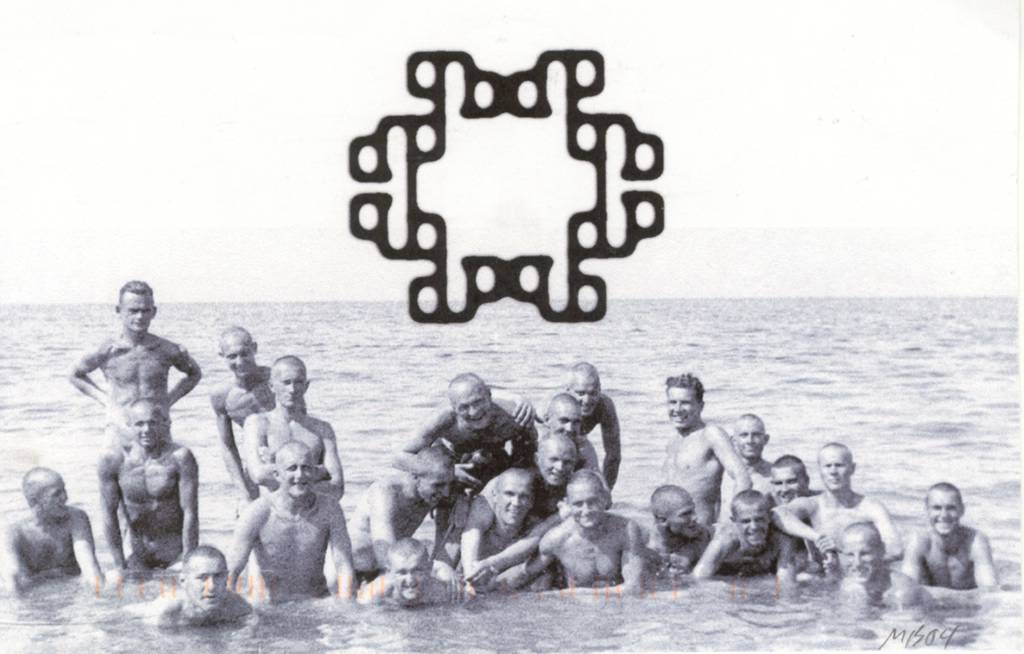
On the other side of the sheet, Q has created a design based on the dbqpnacci sequence in the southeast quadrant. The rest of the quadrants, starting with the northwest, are photographs, which Q identifies as "Fountain of youth," "hmbrella" (great title), and "reflection."


Qpidoremix, [Quadrants] (Oct 2004)

un violon d'ingres

McDonald's October Recyclings

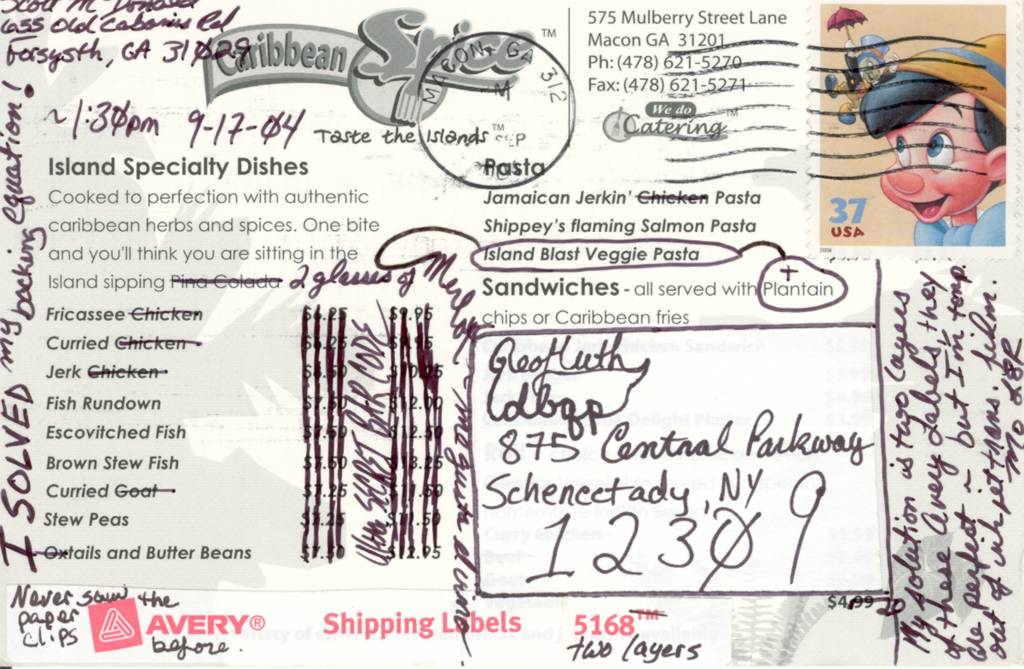
Scott McDonald has (or had) in his possession a number of used postal cards (the USPS's term for a postcard printed by the Postal Service complete with postage). He has slowly been recycling and redistributing these 1-cent cards as a form of mailart.

Votatile

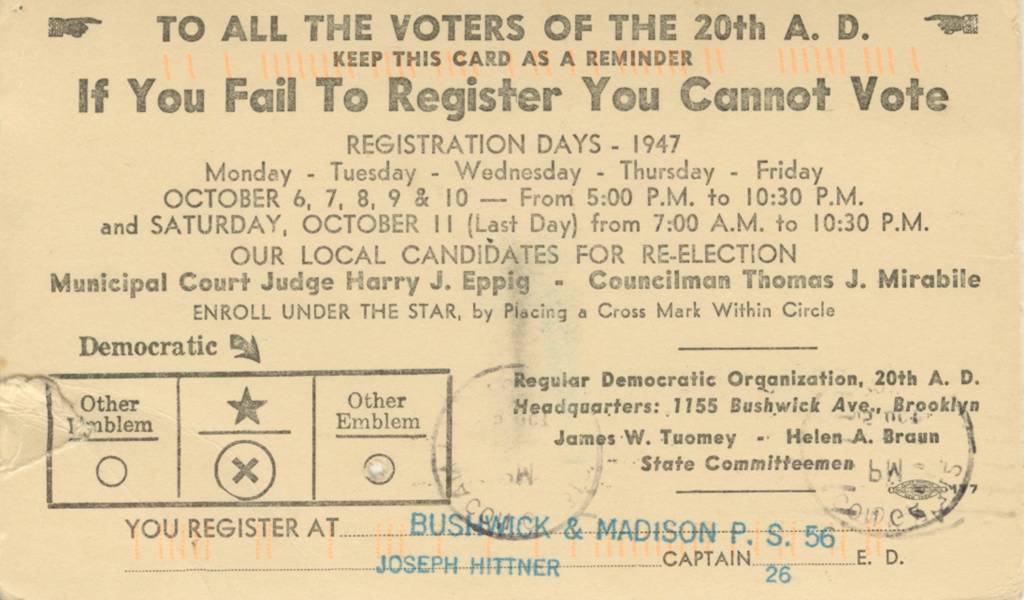
Scott is, apparently, thinking of elections (the 2000 elections, with vote-counting questions in Florida, and our current presidential election about to occur). Originally, this card was mailed to Katherine Praetz of Brooklyn, New York, on 2 October 1943. Sixty-one years and three days later, Scott turned the card upside-down and addressed and mailed it to me. The card, originally mailed out by the Democratic party, urged Katherine (of the 20th assembly district) to register to vote by October 11th, and the card explains precisely how and where and when to do this. Scott, mimicking the punchcard voting system of parts of 2000 Florida, punctured the card, as if voting himself.


Scott McDonald, [Voting Registration Reminder] (5 Oct 2004)

Lou Reed, Haiku

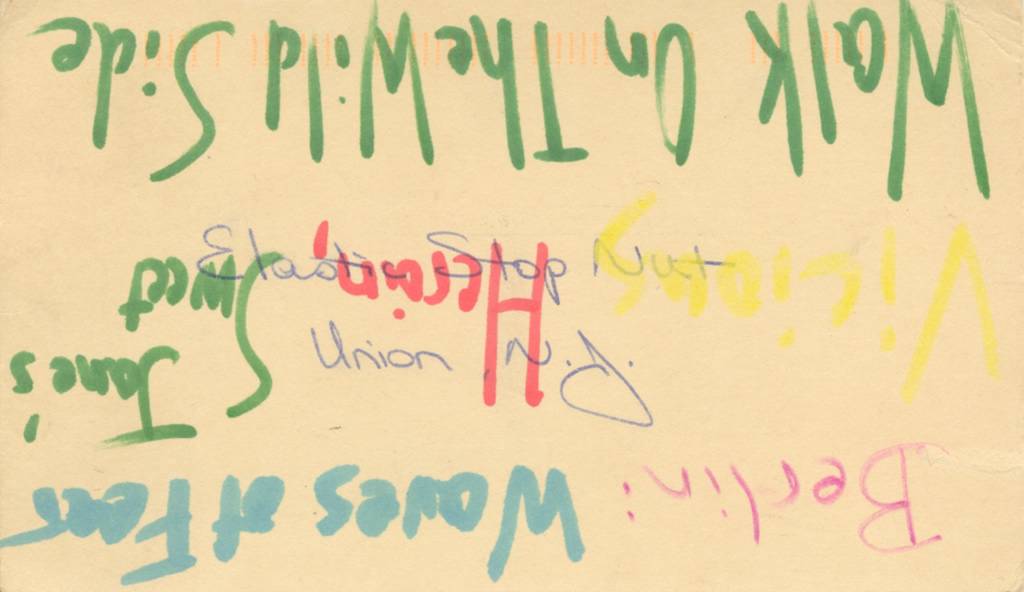
Scott's other recycling is a card mailed to Mrs. J. M. Leonard (of New York, New York) from Plainfield, New Jersey, on 13 February 1943, with this most quizzical message:
Elastic Stop Nut
Union, N.J.
Over this message, Scott has written (in purple, blue, yellow, red, and green) a "haiku" created out of titles of songs from Lou Reed's solo career and his career with the Velvet Underground:

Berlin: Waves of Fear
Vicious, Heroin, Sweet Jane's
Walk on the Wild Side

Scott McDonald, "Elastic Stop Nut"/Reed Haiku (Oct 2004)

un violon d'ingres

Matangi Isle Post Lucy Housewife Cinquain

So cruel am I to my readers that I am depriving you of the obverse of this card, which is the heavily pixellated face of a young Lucy Ricardo (Lucille Ball), her hair up in the manner of a 1950s housewife, with her lips a shocking red and green eyeshadow lurking over her peepers. This is such a stunning image and remarkable mailing that my wife took this to her high school creative writing class for a short mailart unit. (Sometime soon, I will have to report on the results of that unit, but not until the kids' mailart flows into our home.)

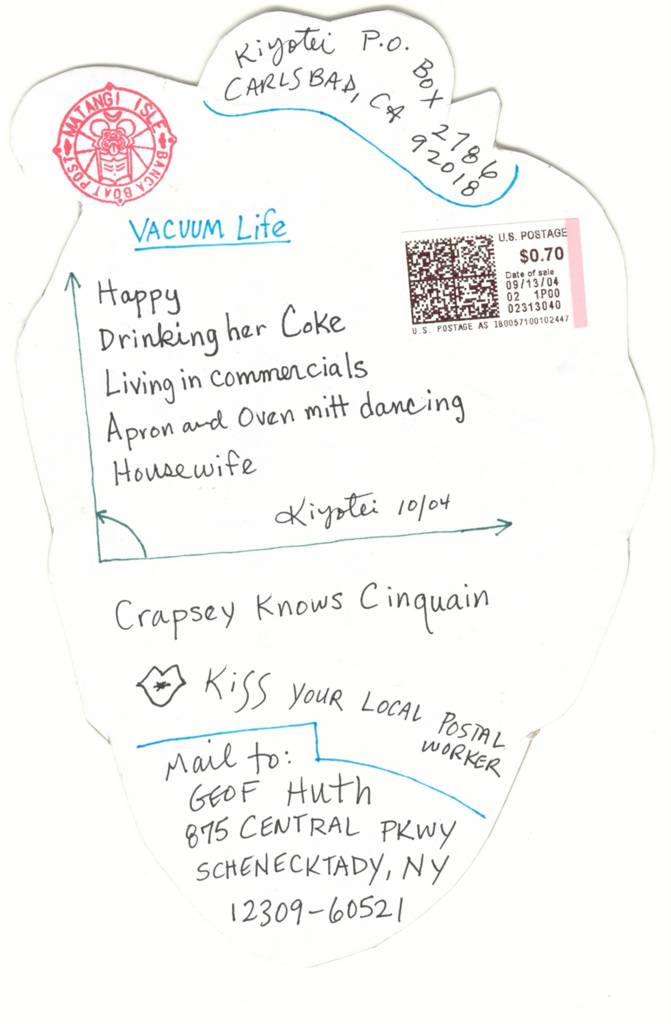
This card is another surprise from kiyotei, who experiments with methods of creation and forms of work all the time. Even given his past surprises, I was amazed that kiyotei created this piece. He took the image of Lucille Ball as housewife and created a cinquain about housework on the back. Not only that, though: he also made a reference to Adelaide Crapsey, a minor poet most famous for creating the cinquain, an American form based on the "syllable"-count Japanese poetic forms (haiku and tanka).

kiyotei writes a poem using the original cinquain form (a 2-4-6-8-2 syllable count that somehow always reminds me of the shape of the Shakespearean sonnet). The form most people learn is a weird and deadly transmogrification created by English teachers to teach kids the parts of speech. These horrible cinquains consist of five word-counted lines in this pattern: one noun, two adjectives, three gerunds (AKA "verbs"), four adverbs (as I learned it), and another single noun.

If I weren't lazy right now, I'd go up to the third floor, and pull out my archives to find the cinquains I wrote in the eighth grade in Calacoto, Bolivia. But lacking that, enjoy kiyotei's work, not just the poem, but the right-angled bracket for the poem, the Matangi Isle postmark, etc.


kiyotei, "Vaccuum Life" (Oct 2004)

un violon d'ingres

Three Blue Cards from Boyle in Pennsylvania

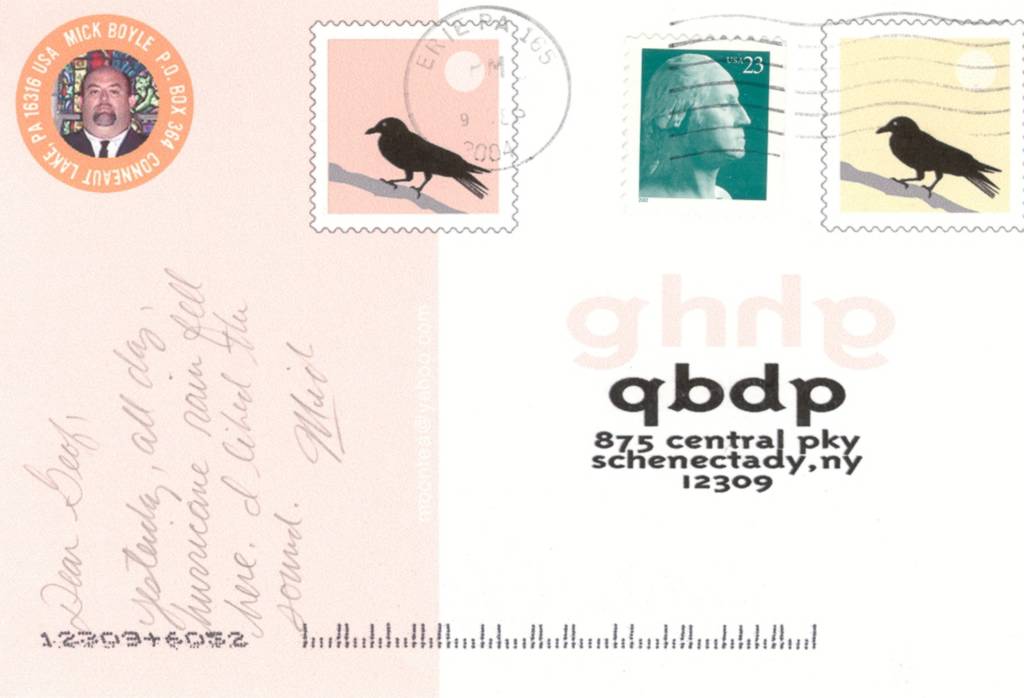
I cannot say for sure when each of these cards from Mick Boyle left Conneaut Lake, Pennsylvania, for Schenectady, New York. The first two are postmarked 5 Oct 2004, but all I can read is "Oct 2004" on the postmark from the last one. I'll treat them all as if they came to me at once, but the third arrived separately.

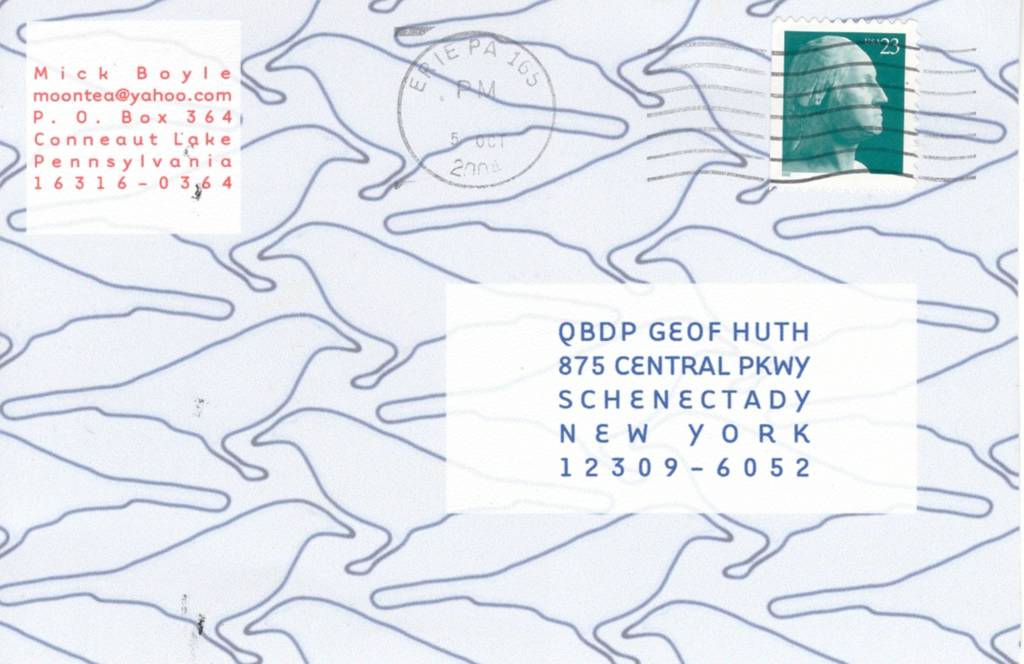
The first card is just another example of the fine typographic design created by Mick, who's certainly the most accomplished typographer I deal with. He has taken the blue outlines of a number of identical birds and fit them together in a pattern similar to those designed by M.C. Escher. But I also love the text: the red return address, the offsides tail of the Q in QBDP, and the inclusion of a Greek capital E in the chosen typeface.

I chose this side of the card (too lazy to do both as I try to catch up with mailart documentation) because I think the card may be presenting us bluejays, and therefore it echoes Roy Arenella's bluejaypost. But the "message" side, also presented in blue, is an interesting jigsaw of images: a tv-scan-lined images of a young man, a drawing of a pair of feet across the grain of a wood floor, a bound man with his mouth taped, and about a third of a naked man who is tattooed as "Joe" and whose left eye is barely visible to our own.


Mick Boyle, [escherbirdpatterning] (Oct 2004)

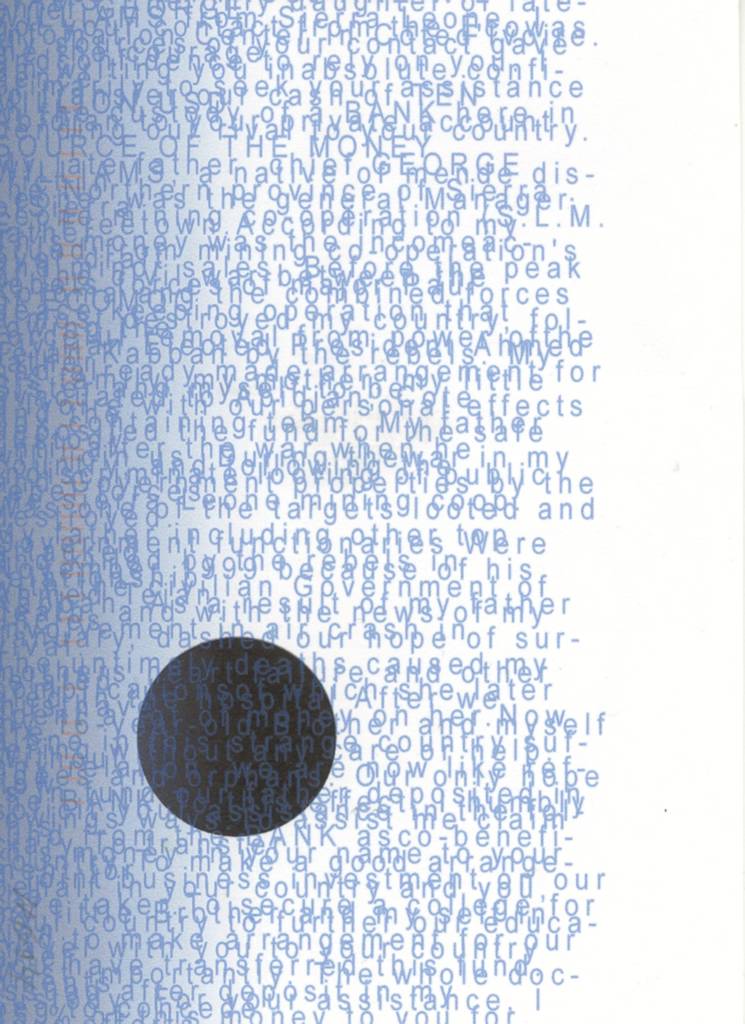
On the face of this card, Mick writes, "here is one way to deal with spam." And it is a beautiful solution to spam. I like how words suddenly jump out of the text announcing themselves before falling back into tumult.


Mick Boyle, [spamtextvisualization] (Oct 2004)

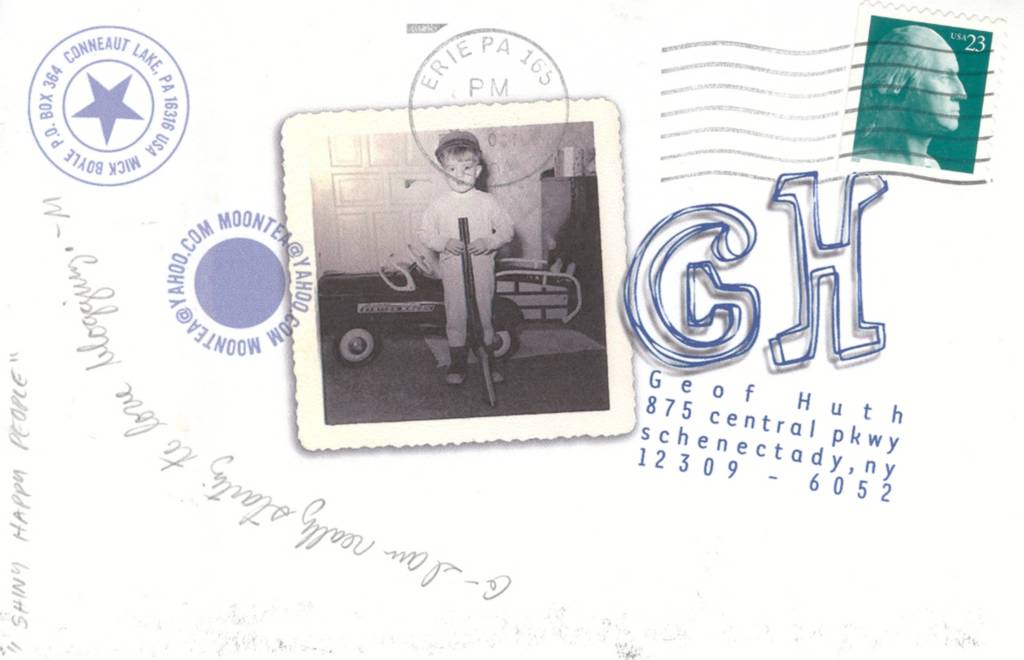
This old almost-deckle-edged snapshot is a beautiful composition, and the design I once again love. We miss, however, the "SHINY HAPPY PEOPLE" who are arguably the central subject of this card. On the reverse is a blurry close-up of three very pink and quite shiny men, who are smiling at something to the right of me.


Mick Boyle, [snapshotpostcard] (Oct 2004)

un violon d'ingres

Bluejaypost

The obverse of Roy Arenella's card (from 28 September 2004 or so) reports the blue jays were prevalent "this week" in his area of the world (Long Island, New York).

This calligraphic card is a rarity among Arenellanisms. Made up of five letters and a hollow tittle over the i, the word "biRdS" is a visual pwoermd. In some way that I cannot express, the look of each of these letters is birdlike. The S is definitely birdshaped: an avian swoop. The bellies on the b and the d suggest the carriage of a pigeon (though not quite a bluejay). The R, with its right leg swooping low and away, is a walking bird. The tittle is maybe an egg. And the b, the p-like R, and the d in a row suggest something of the bobbing of an ambulatory bird. Over the past few weeks, I've been drawn back to this imagetext, but I still cannot quite explain why. I've just tried, but I'm missing something, or much.

The side of the card includes Roy's occasionally-seen Japanese-style signature stamp. Look closely, and you will see that the stamp is not in Japanese characters of any kind. Instead, the stamp spells out "ROY" in Latin letters given a Japanese look.

This card is mailing 419C (a card and the 419th mailing of the year), and it is another maximaphilist adventure. The card concerns blue jays, the pseudo-cancellation includes a rubberstamping of a bluejay, and the card is postage stamped with a 20-cent blue jay and a 3-cent bluebird. Will wonders never cease?


Roy Arenella, "biRdS" (28 Sep 2004)

un violon d'ingres

Found Poetry from Belgium

Luc Fierens has rubberstamped the address side of his recent postcard with the words "FOUND POETRY," and the rest of that side is covered with stampings and labels, images and words in the usual Fierensian style.

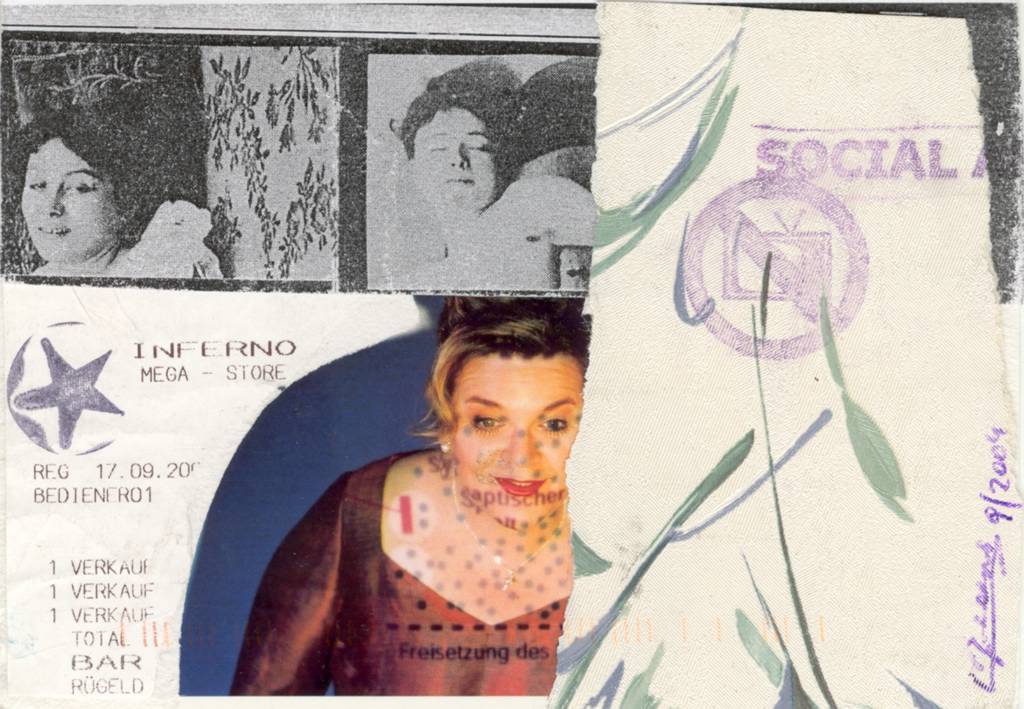
The obverse of the card is a multi-media collage that includes but a few words (so not exactly found poetry). The collage includes photocopied images, a cash register receipt, a color photograph, and a bit of wallpaper with a couple of purple stampings, a signature, and a date. These pieces are joined together to fill the space together. There is no attempt here to construct another visual story with these pieces. Instead, we have the Bern Porter method of collage: slivers of images and text added to the same space to suggest disorder, even chaos, to suggest the lack of suggestion.


Luc Fierens, "Social" (27 Sep 2004)

un violon d'ingres

Mail from Three Places Sent on 27 September 2004

Dr. Strangulensis Continues

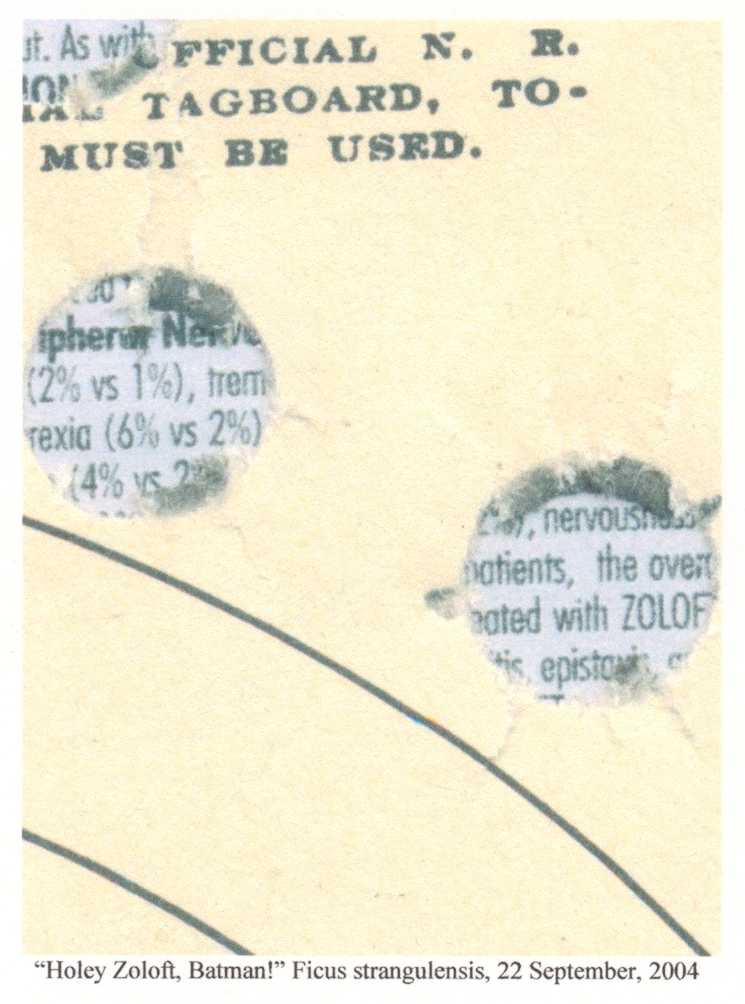
Last I heard, Ficus strangulensis planned to recede into temporary mailart semi-retirement to take care of his parents, so I was surprised to receive another Ficus mailing bundle. Fike always sends an envelope of pieces: a table listing recent email received and sent, a note written on the sheet with the table, bunches of little cards (two cards of textual collage, an abstract painting/postcard entitled "Slewage Doubled Spindle four"), and always a text or collage or something printed directly on the envelope (this time, "Hebephrenic detail for Ack [from R.A. Wilson's "Shrodinger's Cat"].


Ficus strangulensis, "Holy Zoloft, Batman!" (23 Sep 2004)

Arenella Pulls it All Together

Roy Arenella sends me a photocard that explains where he found the "house/tree image in 'Hurricane's Alphabet'" (which I identified as a house destroyed in the Johnstown Flood). The altered photo on the postcard somehow ties this issue together. In "Hurricane's Alphabet," Roy used a photo from a flood to represent damage from a generic disaster. Nothing wrong with that, and his card made its point well. The whole worked well, and that parts didn't have to be truly parts of a hurricane.

In this card, Roy has taken a simple photograph, crisply photographed but almost unremarkable, and he has enhanced this through an adamic process: he names the pieces in the photo. The solid black window, painted and barred, is the "WHOLE," and giant shards of something on the ground are marked "P," "A," "R," "T," and "S."

This is mailing number 408XP/C.


Roy Arenella, "Whole & Parts" (21 May 2004)


Flying Paper (Air)planes through the Mail

Scott McDonald sends a small card that successfully bonds an slip of inkjet-printed plastic (with the negative image of a paper airplane) onto a piece of card. Beautifully bonded, but all I can wonder about is the longevity of the technique!

Scott also reports that "'FATE' was a very trippy thing to find in my mailbox yesterday..."


Scott McDonald, [ghostpaperplane] (Sep 2004)

un violon d'ingres

Arenellamail and Altemuspost

Arenellamail

Returning to my accumulated mail, I discover that the earliest one, from almost three weeks ago, it's a photocard mailed out by Roy Arenella on September 23rd.

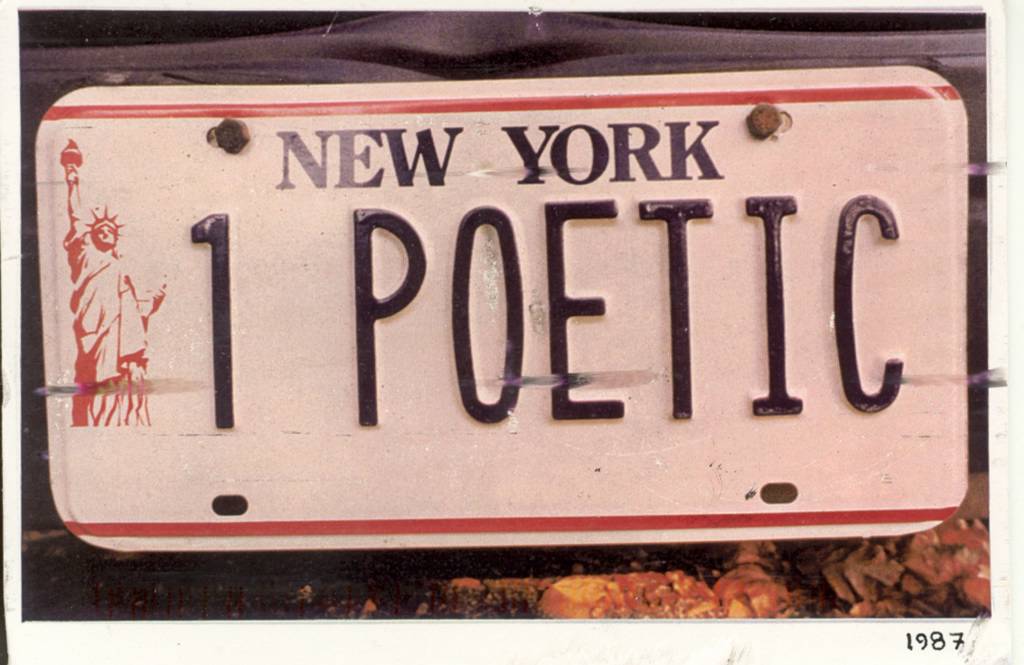
Roy is often a documentary visual poet, a photographer who finds texts in the wild and captures them in their native environments. The photograph on the obverse of this card is a simple capture: a license plate, from the state we share (New York), with the message "1 POETIC." On my copy, the rollers used to move this card through the mailworks left smudges on the card. These smudges suggest speed and movement, which is appropriate since Roy uses this card to tell me he's traveling with his wife (Martine) and dog (Dash) all over that part of upstate New York to the west of me.

This card is number 405 CXP/C, meaning it is the 405th mailing and also a photocard with color xeroxing. The pseudo-cancellation includes a wavy red rectangle inside of which we find the characters, "NY!" Roy is (was) traveling the state!


Roy Arenella, "1 POETIC" (1987)

Roy addressed this card to "gE(+)F UTH." The presentation of my first name, which I very much enjoy, follows a common Arenellan pattern. But the UTH without an initial H is new. There is no way that Roy could know that Uth is actually one of the forms of my surname, not necessarily a "correct" form, but it is one form that h-dropping priests, guessing a spelling, entered into sacramental registers in Alsace, France.

Altemuspost

On the same day that Roy sent me his card, Reed Altemus sent me a large envelope of mailart, decorated with colorful artists' stamps.

Inside the envelope there are, according to Reed, "Some recent and not-so-recent page works & stamps. Also some small treats of the networking variety":

The note quoted above on a Lettrism Against Fascism postcard.

Three "Typollages," rectangles filled with a beautiful collection of asemic type speciments in full paragonnage.

A copy of the zine, Unarmed, out of St. Paul, Minnesota.

An announcement for the assembling project, Floss.

Two remarkably vibrant color xerox "collage journal" pages.

A couple of sheets of photocopied text movements.

"100 Percent Recycled Mail Art Content Stampsheet No. 3"

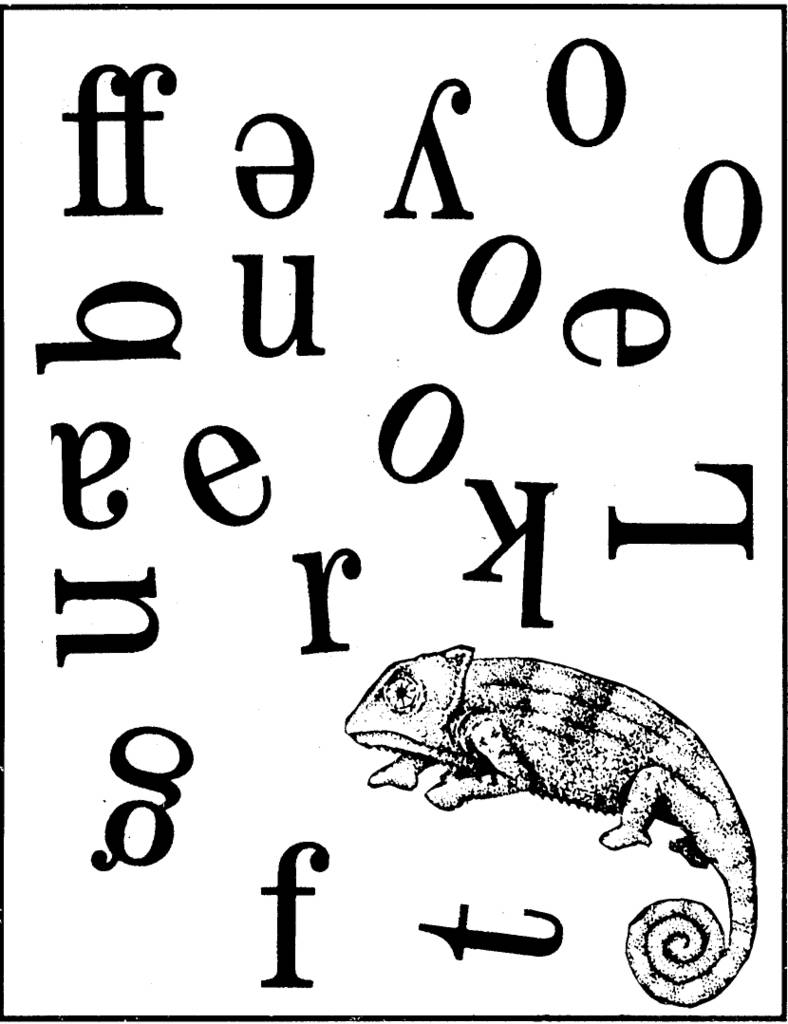
Three other visual poems (my favorite includes a chameleon surrounded by a mishmash of letters).

Weirdest of all, Reed has included a small card with the words "THANK YOU" in raised lettering, though I cannot imagine why Reed would thank me!


Reed Altemus, "ffeyo" (2004)

un violon d'ingres

Monday, October 11, 2004

MY NAME IS (qbdp # 35)

I created a simple card while still out at the lake today. I took free cards picked up in New York City last year: bright red faces (each with a separate sentence, like "Take charge / of your love life."), each advertising the ABC reality show, The Bachelor.

In this environment, I scratched out three labels, each meant to represent a name badge such as people sometimes wear at professional meetings.

The recipients of "MY NAME IS" (qbdp # 35) are the following:

1. Ruth and Marvin Sackner

2. Bob Grumman

3. Roy Arenella

4. Erin Huth

5. qbdp

Geof Huth, "MY NAME IS" (11 Oct 2004)

un violon d'ingres

Sunday, October 10, 2004

Danauzgy (qbdp # 34)

Still Point, Garlock Road, Caroga Lake, New York

I've let this "responsibility" of my life (qbdp) slip a bit over the past couple of weeks. I didn't keep up with my process of recognizing my mailart correspondents, held back too much by sickness, travel, and preparation for travel. Worst of all, I didn't even release an "issue" of qbdp on two separate nights away from home over the past week. Last Sunday, I slept on a plane, taking a redeye back east from Los Angeles, so I didn't have the energy to create a set of cards while I was flying--and what would the other passengers have thought? And two days later, I was away from home again (in Elmsford, just outside of White Plains, New York), and I was so sick and busy that night (not getting into my hotel room until about 11:30) that I gave up the idea of producing an "issue."

In the next few days, I will add illustrations to my more recent entries below and I will return to a discussion of the mail I've received over the past couple of weeks. Catching up should be interesting.

Today, I made up for my laziness regarding qbdp's by producing the most complicated one yet, a small found card decorated with a fidgetglyph and other handwriting and stored within a handlettered envelope.

The carrier for this mailing is a grey invitation envelope with a bold address in black covering most of its front. The reverse includes two return addresses: My home address on the premlip, and a partial address for this camp I'm writing from just under the premlip.

Inside, there is a found card. I had sixteen of these, so I made sixteen mailings. The card is a grey laid card printed on one side: a vinelike decoration around the edge, a logo (a boy riding a giant grasshopper jumping over a giant H that protects a smaller H between its two legs) at the top of the page, and a simple message ("Holiday House / is coming to town"). I can no longer remember where I found these cards, but they are interesting.

Under this logo and message (or emblem and verse), I wrew a small fidgetglyph called "Danauzgy," which is a simple fidgetglyph about vision and the interpretation of what we see.

The "colophon" for this issue I wrote within the openings between the entwining tendrils of the edge decoration. This colophon includes the qbdp number, the date of creation, my name (as author), and the sequential number ("1/16," etc.). I also added "UT" between the two aitches under the grasshopper--thus spelling out my name. Finally, I colored the logo in red, green, brown, and blue.

Since this is a holiday card (apparently celebrating Columbus Day), I wrapped the card in a ribbon made of a cutting of Berroco Mosaic FX yarn, which looks something like two lines of thread held together with a series of thick rungs.
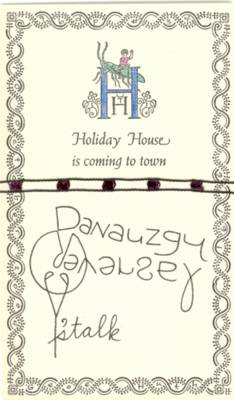

Geof Huth, "Danauzgy" (10 Oct 2004)

On the back of the card, I wrote a unique message to each of the recipients.

These are the lucky recipients of "Danauzgy" (qbdp # 34):

1. Ruth and Marvin Sackner

2. Robert Grumman

3. Roy Arenella

4. Mick Boyle

5. kiyotei

6. Ficus strangulensis

7. Scott McDonald

8. Ross Priddle

9. Reed Altemus

10. Luc Fierens

11. j0llyr0ger

12. endwar

13. Dees and Yuriko Stribling

14. Angelica Paez

15. Erin M. Huth

16. qbdp

un violon d'ingres

Saturday, October 02, 2004

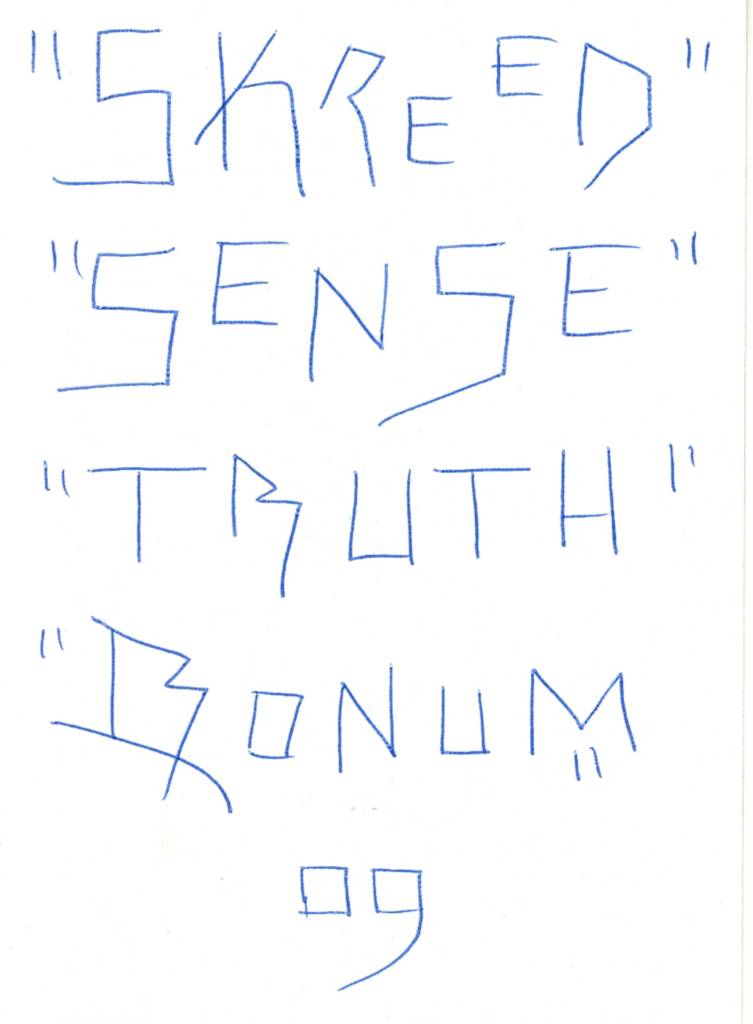
"SKREED" (qbdp # 33)

Courtyard by Marriott, Room 310, Long Beach, California

I flew across the country today, little thinking what I'd create tonight but knowing I should plan to do something for tonight. As I was waiting for a shuttle to the airport, I found a graffito carved into a pole. This small graffito (with silver letters in a brown pole) was a great bit of inspiration, and tonight's "'SKREED'" is a reworking of this found text.

The recipients of "'SKREED'" (qbdp # 31) are as follows:
1. Ruth and Marvin Sackner

2. Bob Grumman

3. Roy Arenella

4. Erin Huth

5. qbdp


Geof Huth, "SKREED" (2 Oct 2004)

un violon d'ingres

Friday, October 01, 2004

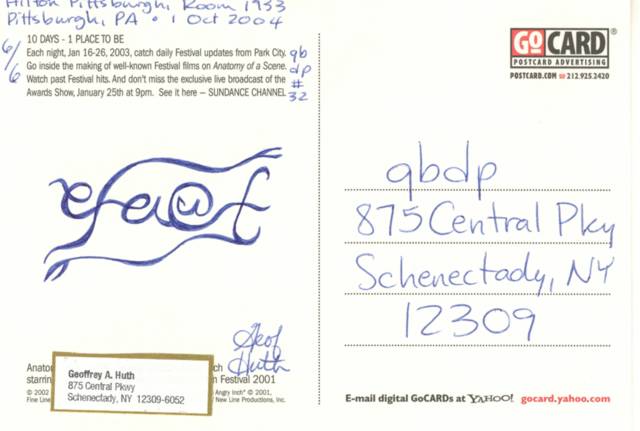
(eyg)(eau)(auo)(Eft) (qbdp # 32)

Hilton Pittsburgh, Room 1933, Pittsburgh, Pennsylvania

Today, I wrew a tiny fidgetglyph where each character represented three separate characters. To ge the right effect, I had to wraw these with a ballpoint pen.

The recipients of "(eyg)(eau)(auo)(Eft) " (qbdp # 32) are as follows:

1. Ruth and Marvin Sackner

2. Bob Grumman

3. Roy Arenella

4. kiyotei

5. Qpidoremix

6. qbdp


Geof Huth, eyg.eau.auo.Eft (1 Oct 2004)

un violon d'ingres

Thursday, September 30, 2004

wordwinds (qbdp # 31)

Hilton Pittsburgh, Room 1933, Pittsburgh, Pennsylvania

While I watched the presidential debate tonight, I sketched distractedly onto pieces of paper until I found a quasi-verbal design I liked enough not to discard. I thenb wrew the four-color fidgetglyph onto postcards I had cut out of boxes, and that is how "wordwinds" was born.

The recipients of "wordwinds" (qbdp # 31) are as follows:

1. Ruth and Marvin Sackner

2. Bob Grumman

3. Roy Arenella

4. Reed Altemus

5. Ficus strangulensis

6. Scott Helmes

7. Erin Huth

8. qbdp


Geof Huth, "wordwinds" (30 Sep 2004)

un violon d'ingres

Wednesday, September 29, 2004

Apology to My Correspondents

My life is a bit hectic right now and I'm heading out on a week's worth of work-related traveling tomorrow, so this blog will remain a bit behind until my return. I have wonderful things to display upon my return, but it will probably be a little over a week before I start posting the treasures I've received: words on photographs, textual collages, visual poetry without words. The wonders never cease.

un violon d'ingres

Sunday, September 26, 2004

seÏze (qbdp # 30)

Before leaving Caroga Lake, New York, this afternoon, I took five green postcards—each a green advertisement for the movie Shrek2 and for HP, and each carrying a different two-shot of Shrek and his love—and I covered up part of the HP advertising with my return-address label, addressed the envelopes, and wrote a simple visual pwoermd ("seÏze") as each card's message. We mailed them at the Caroga Lake post office as we headed for home.

These were the recipients of "seÏze" (qbdp # 30):
1/5 Ruth and Marvin Sackner

2/5 Bob Grumman

3/5 Roy Arenella

4/5 Erin Huth

5/5 qbdp


Geof Huth, "seÏze" (26 Sep 2004)

un violon d'ingres

Saturday, September 25, 2004

Cartouché (qbdp # 29)

Still Point, Garlock Road, Caroga Lake, New York

Taking a set of postcards from work (of a "1946 artist's rendering of the Catskill section of the New York State Thruway before it opened in 1954"), I wrew a little fidgetglyph in red and blue on the reverse of the card, leaving just a bit of space for a small message to my correspondents. Punningly, I chose "Carouché" as the glyph, and I added a large black "ée" to the obverse of the card, just in front of the car driving a family on the Thruway.

I had some trouble making the glyphs on these cards just right, and then I ended up miswriting my own zipcode on my record copy of the card!

These were the recipients of "Cartouché" (qbdp # 29):
1/9 Ruth and Marvin Sackner

2/9 Bob Grumman

3/9 Roy Arenella

4/9 kiyotei

5/9 Mick Boyle

6/9 Angelica Paez

7/9 Dees and Yuriko Stribling

8/9 Erin Huth

9/9 qbdp


Geof Huth, "Cartouché" (Obverse, 25 Sep 2004)


Geof Huth, "Cartouché" (25 Sep 2004)

un violon d'ingres

Friday, September 24, 2004

Two Today, One Yesterday, None Tomorrow

Still Point, Garlock Road, Caroga Lake, New York

Forged Document Received Yesterday

Roy Arenella sends me an interesting photocollage of a house skewered by a huge elm, and he entitles it “Hurricane’s Alphabet.” As soon as I saw the image, I thought, Isn’t that a picture of the aftermath of the Johnstown Flood. My wife Nancy saw the card on my worktable (which I should more properly call a pileofjunktable) and immediately noted that it was a picture from the Johnstown Flood.


Roy Arenella, "Hurricane's Alphabet" (5 Jan 2004)

Nancy and I are tied together in a number of strange ways. We both are descended from Swiss Stutzmanns, all of whom we trace back (or can almost trace back) to one small village in Switzerland. So we probably have a couple of joint ancestors from about 400 years ago. Also, we are tied together by a familial connection to two of the greatest disasters of a century ago: The Johnstown Flood of 1889 and the San Francisco Earthquake and Fire of 1906.

Nancy’s ancestors survived the Johnstown Flood, but witnessed the breaking of the dam high above the narrow valley cutting through the hill into Johnstown. Starting on page 99 of David G. McCullough’s Johnstown Flood, we find this description of Nancy’s great-great-uncle and great-grandfather:

George Gramling, who had a mill on Sandy Run, started off for the dam about eight in the morning along with Jacob Baumgardner [Nancy’s great-grandfather, whose saw we still use to cut wood] and Sam Helman. The Gramling mill was operated by a small dam which had broken about seven. If a small dam washed out that early, the men reasoned, what would a big dam do later on?

My grandmother lived through the San Francisco Earthquake in 1906. She was but six at the time, and she once told me that all she really remembered was sitting on the curb of the sidewalk after the earthquake. Her father, a printer turned mortician, was a well-known man in the Mission District and somehow was instrumental in bringing order back to the city.

So these two stories of two of the most famous American disasters—disasters at opposite ends of the country—tie Nancy and me together as if we were cousins, which we very well might be.

So Nancy and I realized the forgery immediately. “Hurricane”? We think not. I called Dan Rather of CBS news to ask him what to do in such situations, but he would not take my call. In the absence of any advice, I am unable to help Roy deal with this forgery. Instead, I present this information: This photograph is clearly a picture of the Schultz home. As a matter of fact, it is exactly the same photograph of this house that appears in the aforementioned Johnstown Flood. Of it, McCullough’s writes:

A favorite subject for the swarms of photographers who rushed to cover the disaster was the house belonging to John Schultz. It had been neatly skewered by a huge tree and then dumped down near the Point. Six people were in it when the wave hit. Miraculously they all came out alive.

Wait, wait, wait. What does all this have to do with mailart. Back to the card. Roy addresses me by an ancient, yet still current, familial nickname of mine, then thanks me for some recent mail. This card, created on 19 Sep 2004, is numbered 400 CXC (color xerox card). Let’s hope Roy isn’t tricked by any other forged captions in the future. (Okay, I know Roy wasn’t really fooled by anything. He just liked the idea of hurricane better than that of flood.)

When we arrived at this Adirondack camp tonight, planning to stay for two nights, I decided to place my clothes in a drawer in my father-in-law’s dresser. When I moved the socks in the drawer, I found a single postcard, published by the Johnstown Flood Museum: a different view of “Schultz Home—Main & Union Sts.”

Rebusing versus No Busing at All

kiyotei sends me a card cut out of a piece of cardboard, glossy and printed on one side, the side where he decides to place my address—atop labels atop the text of the card. On the other side—which I can’t decide whether to call the obverse or the reverse—he has outlined in pen and colored in pencil a simple humorous rebus.


kiyotei, [Time Weights for No Juan] (Sep 2004)

At qbdp Beach

Mick Boyle sends me yet another of his beautiful inkjet-printed cards. This one gives us a clearer view of a picture Mick sent in an earlier card. He has pulled the camera back and we can now see all these beach bums of qbdp Beach.


Mick Boyle, [qbdp beach boys] (Sep 2004)


Extroit

Since we’ll be here, I won’t receive any mailart tomorrow.

ecr. l’inf.

Wednesday, September 22, 2004

A Week’s Worth Plus "FATE" (qbdp # 28)

Southgate Tower, Room 2508, New York, New York

I’m so far behind in talking about mail that I will do this briefly and incompletely, but at least there are still pictures!

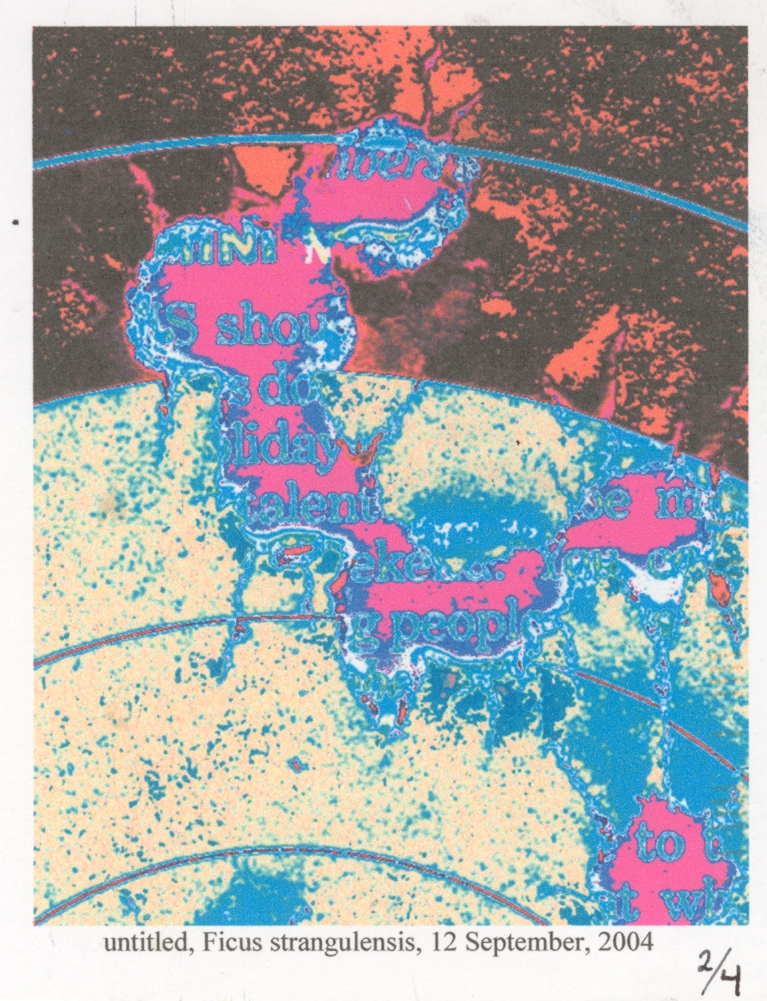
Ficus strangulensis sends this image but reports:

Dear Mail Art Correspondent, I may be out of touch for a while [helping care for my parents]. At least that’s the ‘plan’ right now.
Yor ol’ bud, Fike 14 Sep ‘04


Ficus strangulensis, Untitled (12 Sep 2004)

Scott McDonald sends we a weird “altered” postcard, which explains to me (though maybe not to the general public) that he has figured out how to postcardize inkjet transfer film.


Scott McDonald, Altered Postcard (17 Sep 2004)

Roy Arenella sends another surprise. A V-mail letter fifty years after the fact, and he’s stuck a postcard inside the thin skin of the V-mail envelope—which reminds me of my Portuguese childhood when the cook would find a whole sardine resting inside the delicate body of a squid. Roy’s letter concerns the spelling of the word “visibly,” which is kind of interesting, given that V-mail was a mode of communication with a number of visible elements: the censor’s stamp (interestingly re-created by Roy on this letter), a particular template that people had to write within, and the fact that most V-mail was microfilmed to reduce the amount of material that needed to be shipped back to the US.


Roy Arenella, V-Mail Note, (17 Sep 2004)

Tonight, I also created a 10-piece issue of qbdp, wrawn upon light-tan, pH-neutral, lignin-free board I found in the trash at work in the form of small boxes and which I cut into 102 small postcards.

These were the recipients of “FATE” (qbdp # 28):

1/10 Ruth and Marvin Sackner

2/10 Bob Grumman

3/10 Roy Arenella

4/10 kiyotei

5/10 endwar

6/10 Scott McDonald

7/10 Ficus strangulensis

8/10 j0llyr0ger

9/10 Erin Huth

10/10 qbdp


Geof Huth, "FATE" (Sep 2004)

un violon d’ingres

Thursday, September 16, 2004

The dbqpnacci Sequence in the Clouded Skyboard

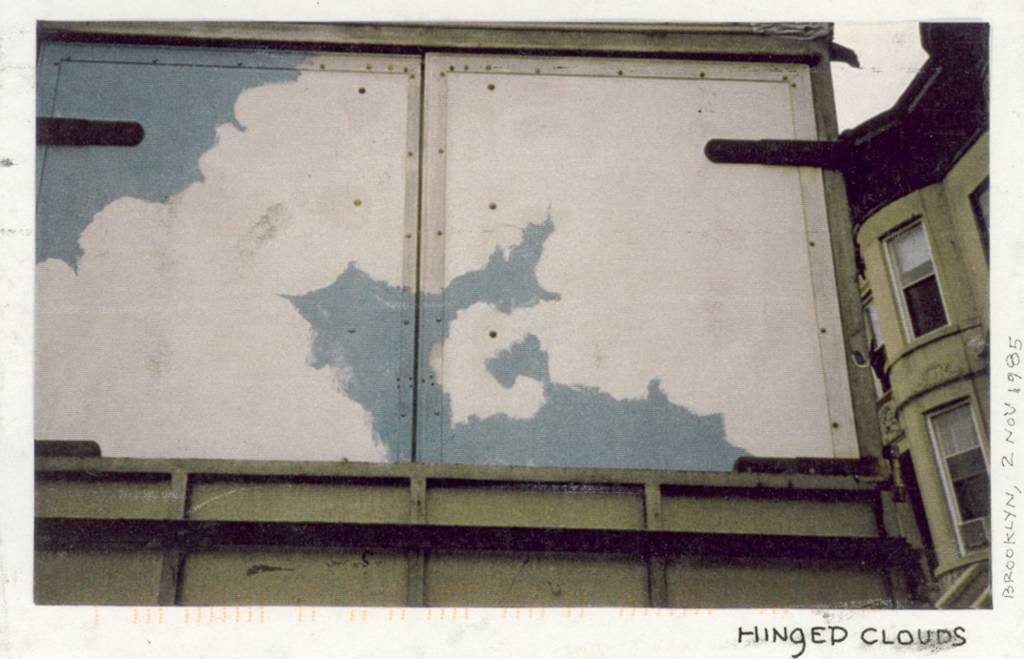
I am struck, when looking at the obverse of each postcard I received today (one from Roy Arenella and one from Mick Boyle), how similar they look. The qbdp subsequence of the dbqpnacci sequence in Mick’s card, which forms almost a star in its center, resembles the crooked curvilinear “hinged clouds” in the photograph on Roy’s card.


Roy Arenella, "Hinged Clouds" (2 Nov 1985)

Roy’s card is numbered 392 (but without any additional characters—we’d expect “p/c” for “photo/card”). Dated 14 Sep 04, his quasi-cancellation includes a rubberstamping of a cloud, within brackets and surrounding a minus sign, which he says equals “zero cloud” (or no cloud at all). For his stamp, he uses a 32-cent stamp (the anagram of the Postal Service’s required denomination) of the Wright Brothers’ Model B biplane suspended in a delicately clouded sky.

In his note—punctuated as usual with attractive tree-like I’s—Roy wrote that he enjoyed my visual poem “o’cloud” because he found it “manual, low-tech, black & white, constructivist (or at least visably structured) ‘imaginative’ & a little wacky. And it’s about ‘NĀTCHĂ.’” He goes on to point out that there are few good visual poems about nature. Very true, I believe, but his point made me realize that I’ve made quite a few vispoems about nature including my favorite, “HY,” which appears (a big scraggly) here.


Mick Boyle, "qbdp" Obverse (Sep 2004)

Mick Boyle creates clusters of dbqpnacci sequences on his cards, in toto reminding me of the diagramming of a chemical or a DNA sequence. A wonderful sense of design on this card, which he


Mick Boyle, "qbdp" Reverse (Sep 2004)

extends, almost surreptitiously onto the reverse of the card, where a bit of the qbdp subsequence appears in the northwest corner of a picture of men on a beach we cannot see, before a large body of water, and beneath a sky of schematic clouds that appear to’ve been created out of punctuation marks.

un violon d’ingres

Sunday, September 12, 2004

The Visual Pun Revealed in All its Glory,
Including in “mn/wv” (qbdp # 27)

Yesterday, I received a small flood of mailart, yet I didn’t find the time to say anything about these cards until today.

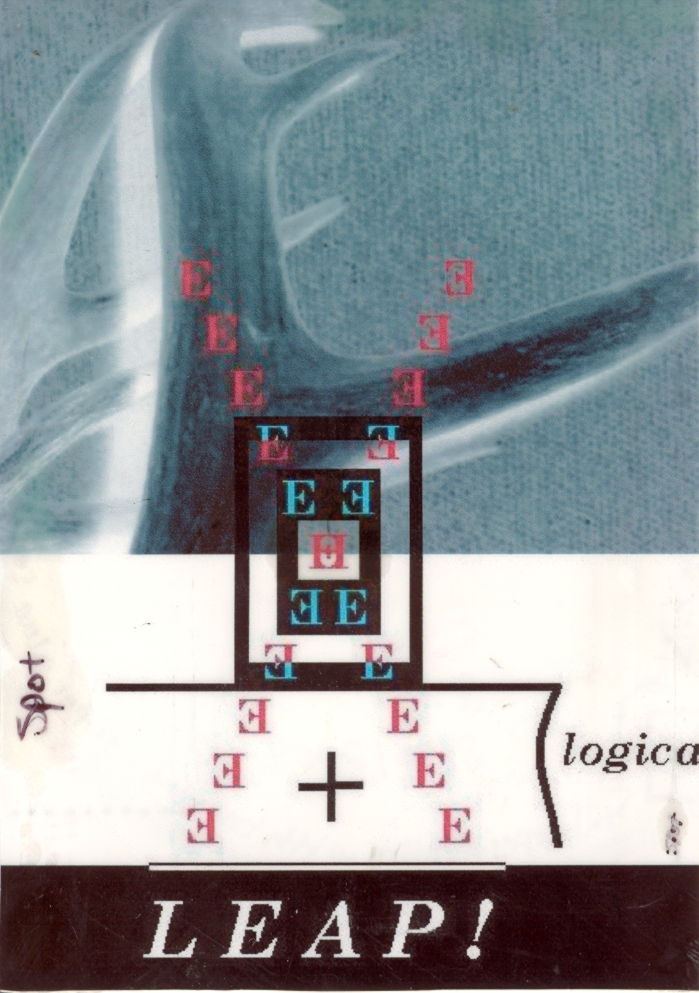
Scott McDonald sent me an envelope, inside of which was a postcard and a letter explaining how he had left my street address off the postcard, had received it back from the post office, and then had misplaced it for almost a month. The card is printed on inkjet transparency film, which gives the color more liveliness than paper. Upon this film he prints one of his wild mathemaku (a form of visual poetry created by Bob Grumman).


Scott McDonald, "LEAP!" (10 Aug 2004)

kiyotei had breakfast on Highway 101, and all I got was this schematic diagram that surreptitiously spells out his name! (I can’t decide if the lower half spells out anything, but I have a guess.)


kiyotei, "Breakfast @ the 101" (Sep 2004)

Mick Boyle sends me a beautiful rendering of what I’m now calling the dbqpnacci sequence (that sequence that creates the names for all my publishing projects). I love the Escher-like overlappings of these perfectly balanced letterforms—especially in this typeface.


Mick Boyle, "pdbq" (Sep 2004)

On the obverse of the card, Mick takes my initials and turns them into a self-mirroring quasi-dbqpnacci form.


Mick Boyle, Card to ghhg (9 Sep 2004)

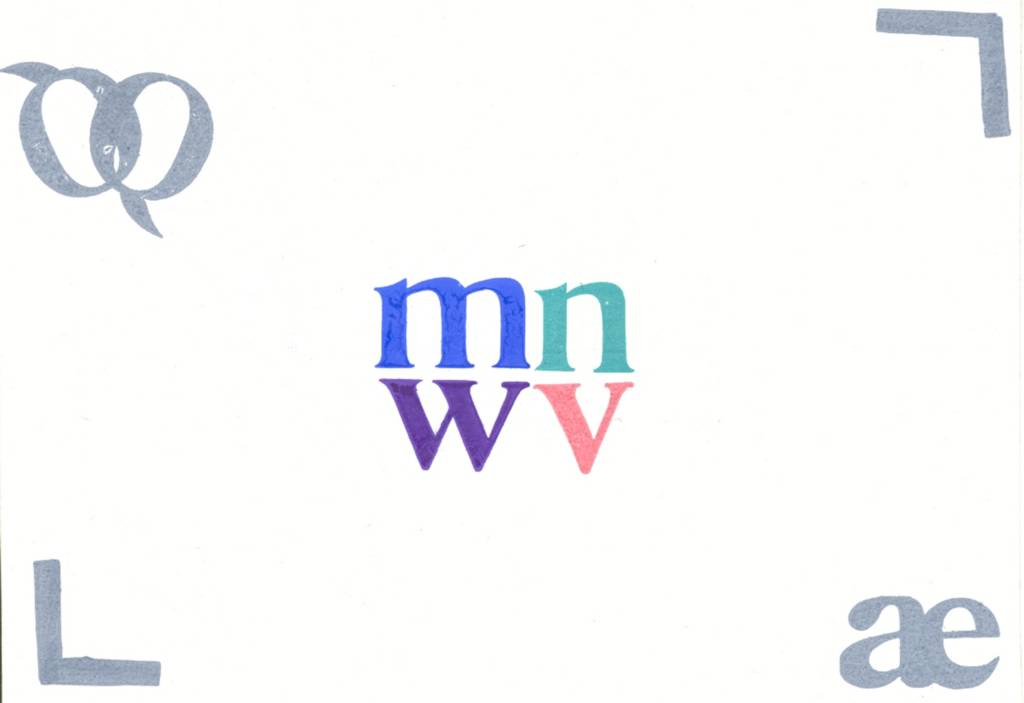
I was amazed by the variety of forms in the mailart, so I created yet another style for these artists and a few other lucky folks. As I sat in the camp at Caroga Lake today, fiddling with rubberstamps, I realized that I could almost-mirror “mn” with “wv” and then make both lines suggest words—suggest something of the place where I was then sitting.

I stamped this small concrete poem, “mn/wv,” on the white sides of some blank sheets of cardboard I found being discarded at work. (After adding the poem to the front, I realized the cards were ¼ of an inch too wide for me to mail it with a postcard stamp, so I trimmed each one by one. Once home, I trimmed all the remaining blank cards.) The reverse of the card is grey, but it served its purpose well, I filled one third with the addresses and stamps. Then I sat on the screen porch in the sun, with a slight cool breeze blowing over my naked toes, and wrote each correspondent a short note of dense green text.


Geof Huth, "mn/wv" (12 Sep 2004)

The following are the recipients of “mn/wv”:

1/12 Ruth and Marvin Sackner

2/12 Bob Grumman

3/12 Roy Arenella

4/12 kiyotei

5/12 Scott McDonald

6/12 Mick Boyle

7/12 Scott Helmes

8/12 Studio 360, WNYC Radio, 1 Centre Street, 30th Floor, New York, NY 10007 (mailart project)

9/12 Qpidoremix

10/12 Luc Fierens

11/12 Erin Huth

12/12 qbdp

13/12 Dees and Yuriko Stribling
After finishing the series, I decided that I needed to send my friend Dees Stribling one of these cards (since he might fathom and then enjoy the pun), so his card is the thirteenth of a series of twelve—or, as I told him, “the baker’s dozenth of a dozen.”

un violon d’ingres

Friday, September 10, 2004

Twoness and Embonpoint in the Mail

Yesterday, two sets of cards: one set of one, and one set of two:

Arenella’s Point

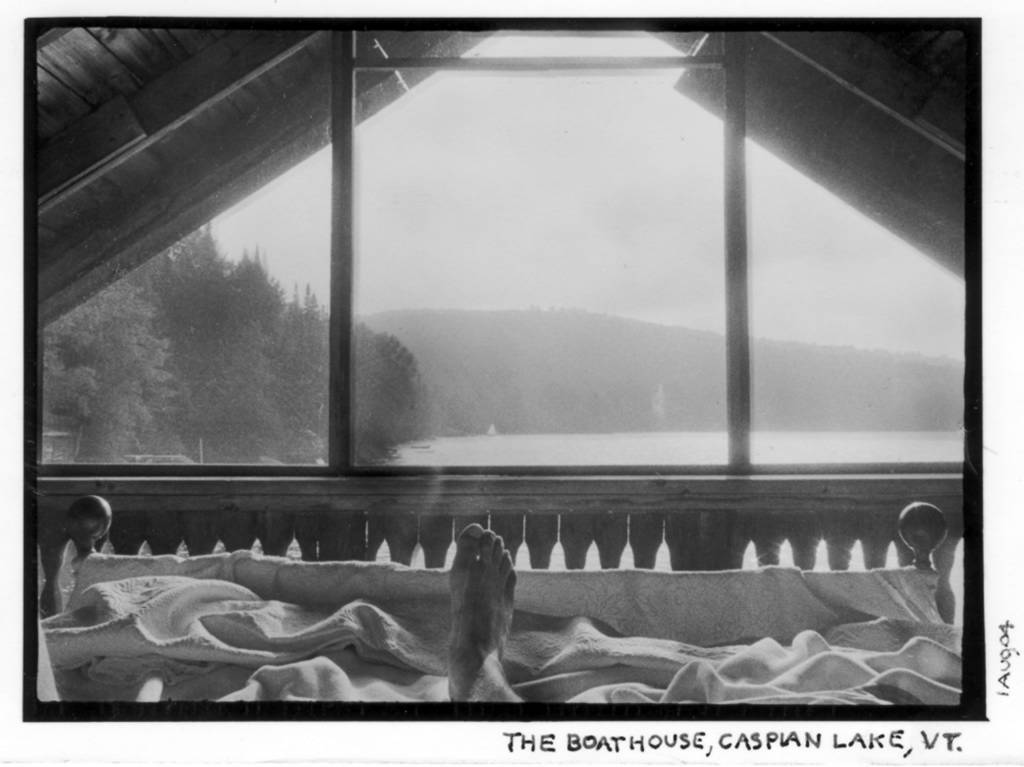
“2 LAKES 2 PEOPLE 2 POINTS” is how Roy Arenella’s note begins. The two lakes are Caroga Lake in New York and Caspian Lake


Roy Arenella, "The Boat House, Caspian Lake, VT." (1 Aug 2004)

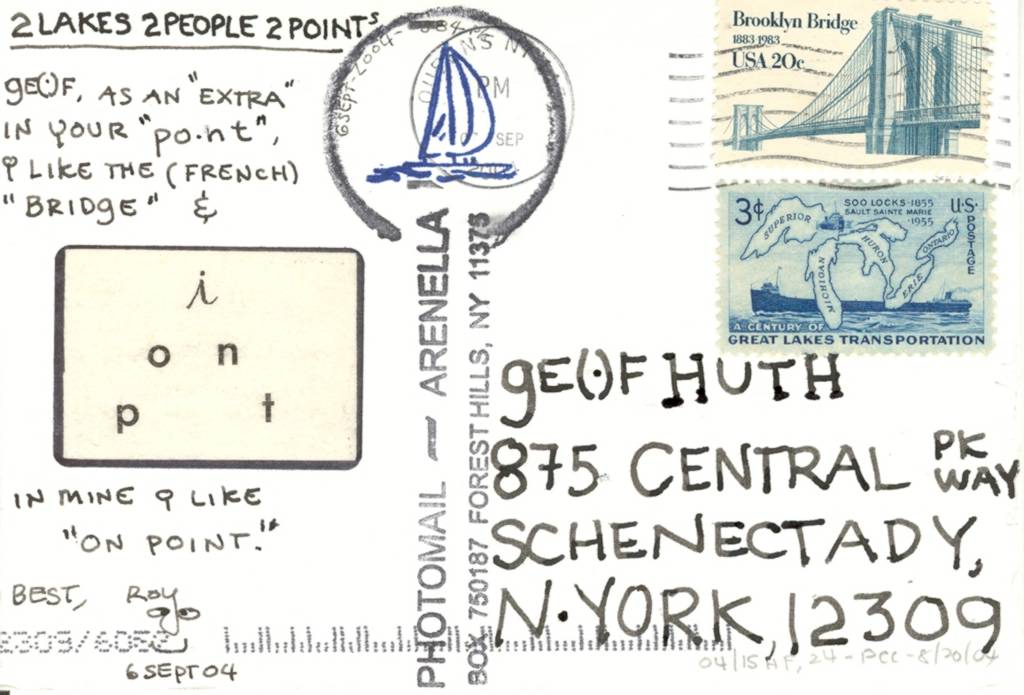
in Vermont. The two people are Roy and I. The 2 points are my version of T.S. Eliot’s “still point” (recently improved) and Roy’s more pointed version affixed to a label affixed to the message side of a postcard:


Roy Arenella, "2 LAKES 2 PEOPLE 2 POINTS" (Sep 2004)

This card appears to be number 384 p/c (the 384th mailing and a photocard). Roy fills his pseudo-cancellation with a rubberstamping of a sailboat and continues the watery theme with a 20-cent postage stamp showing the Brooklyn Bridge and a 3-cent stamp of “Great Lakes Navigation” that unavoidably shows Lake Erie, a lake that literally used to be my backyard.

Two from Boyle

Mick Boyle sends me two cards at once, just as he did the last time. That may be his pattern. One includes a message from Cicero (

Art is born of the observation and investigation of nature.

), and its front shows us two strong men in bathing suits, both decorated with a flowery pattern like that of wallpaper. In the second card, Mick (coming from one of the top swing states in the nation) explains, “I plan on voting, but I’ve noticed some people seem to get a little too excited by politics.” The back of that card, explains the results of voting.


Mick Boyle, Two Postcards (2004)

un violon d’ingres

Wednesday, September 08, 2004

Too Many Yesterdays

Well, it was yesterday when I received these next two.

First is a little wonder from j0llyr0ger, μ (Micro) 1.0, (semi)2otic, the smallest zine I've ever received, maybe 1 inch by 1.5 inches in size. The fourteen pages of this zinelet include bits of dadaistic textual barrage, broken up with the marvelously subtle intrusion of images: a mouse poking its nose into "tatter about," a hand-powered drill surrounding "bordered glaive/then a krait gore/cubic all the file," the corner of some piece of machinery above "circular yaw." The effect is kind of like a semi-collage. Altogether a great job of making a tiny booklet as well, and it's a good read for those of us who still have the eyes for it!

µ (Micro) 0.1 and its Transport Vehicle


I haven't heard from kiyotei for a while, and I wondered why. Now I know: He was on vacation in Utah, in somewhere with the initials KB. It looks like it's near Capitol Reef National Park, but that's all I know. kiyotei is a mapmaker by avocation. I await his next charting.


kiyote, "My Vacation as Viewed from Canada"

It has occurred to me that it is possible that these two gentleman are keeping their true names secret from us.

un violon d'ingres

Monday, September 06, 2004

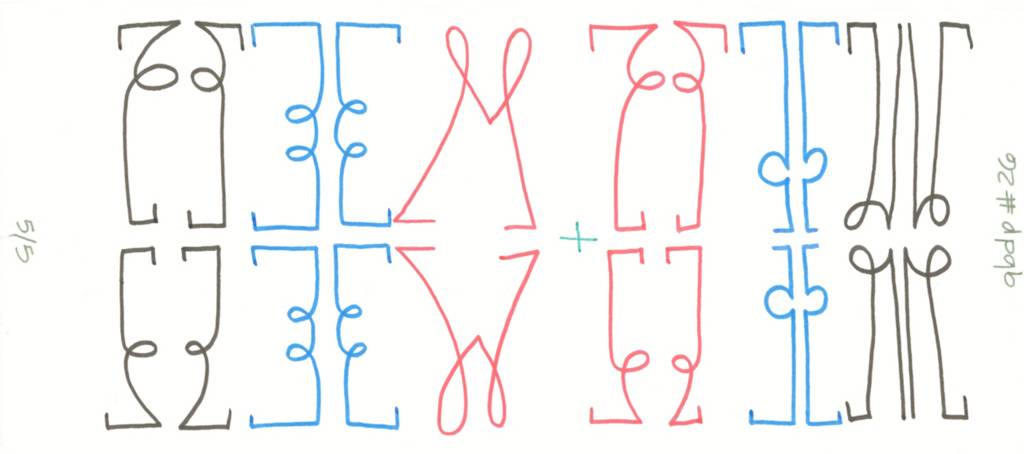
HEM + HaW (qbdp # 26)

Before we left Caroga Lake this afternoon, I put together a small but time-consuming mailing:

Upon sheets of stationery from the Crowne Plaza in Rochester, I placed a vinyl numeral from 1 through 5 in the upper left hand corner (signifying the number of that piece of correspondence in the mailing) and on the bottom third of the sheet I wrew a fidgetglyph in four colors. I had some trouble with this glyph and got none of my tries quite right (and two of the attempts still have out-and-out mistakes in them).

On the rest of the sheet, I wrote a small note to each of my correspondents, each on a different subject. I placed the letters in abandoned UAW envelopes I picked up about 15 years ago. (I'm still trying to use them up.)


HEM + HaW (6 Sep 2004)

To make up for the errors in the glyph, I rewrew the initial H on the back of the envelope just below the premlip. Each of those aitches came out quite well.


The H below the Premlip

These are the recipients of "HEM + HaW":

1/5 Ruth and Marvin Sackner

2/5 Bob Grumman

3/5 Roy Arenella

4/5 Erin Huth

5/5 qbdp

un violon d'ingres
Sunday, September 05, 2004

sp pr rt th hn (qbdp # 25)

Still Point, Garlock Road, Caroga Lake, New York

We are ending the summer in the traditional way by enjoying a damp and cold weekend in the Adirondacks. Erin has left us, ending up at her destination in Dublin, Ireland, without mishap, and today I put together a small mailing using a handful of old postcards decorated with colored images primarily of parks across the United States.

The "content" of the mailing is quite simple: a small visual poem created from a concatenated series of vowelless pairs of letters. The meaning of the poem is clear enough (to me), and the clouds or steam in the photographs on each of the cards help reinforce that meaning. Additionally, I wrote the first and the last line of the poem on the obverse of the card, within whatever clouds I found there.

These are the recipients of "sp pr rt th hn":

1/8 Ruth and Marvin Sackner (The Badlands, South Dakota)

2/8 Bob Grumman (Hornet's Nest, Wisconsin Dells, Wisconsin)

3/8 Roy Arenella (San Francisco)

4/8 Ficus strangulensis (Custer State Park, Black Hills, South Dakota)

5/8 Mark Lamoureux (The Grand Canyon)

6/8 Mick Boyle (The American Falls of Niagara Falls)

7/8 Erin Huth (The San Francisco-Oakland Bay Bridge)

8/8 qbdp (Yellowstone National Park)


Now that my daughter is living in Ireland, she becomes a recipient of these mailings.


sp pr rt th hn (5 Sep 2004)

un violon d'ingres
Friday, September 03, 2004

I Like Fike

Today's mail brought me two pieces from Ficus strangulensis.

The one I read first was a postcard featuring a blue and orange textual collage entitled "Watering Hard Salami." On the back, Fike writes, "Thank you for the enigMatic Map. 24?" which reminded me that I asked people to count how many ems appeared in my visual poem, "Camping by Pharoah Mountain." The other day, Roy Arenella guessed 17, which is actually correct. Mostly, what I made was a picture, a map, with ems (the Medieval symbol for water) representing most of the salient features on the map.

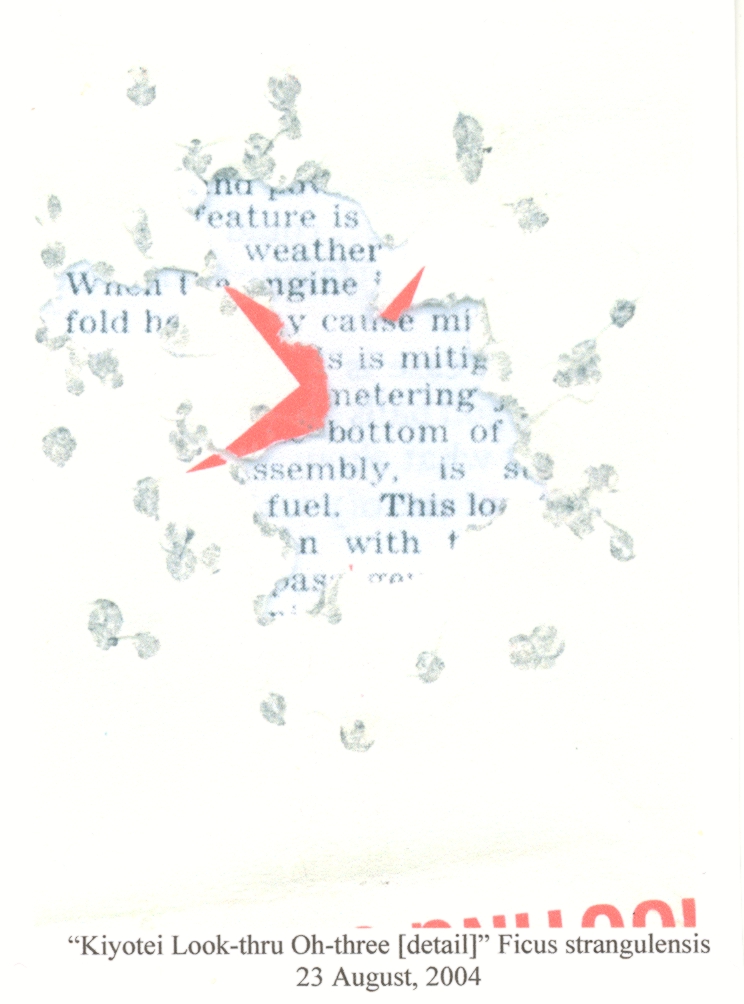
Fike's second mailing is an envelope decorated with a detail from "Langolf's Mermaids' Lip," a text presented so as to appear to be a gene sequence. Inside, Fike has included three of his cards, including one with "Kiyotei" in the title. Fike also includes his usual tabular printout of mailart sent and received along with this note:

Hi, Geof, once again, I feel I've 'flunked'. Sigh. (my instant impressions ["Gee!, Geof, I'm mystified [glyph repeated front/back resembles robot or test tube with wry smile"] didn't come to closure nor (probably) begin to 'hit' it. Great old pic of A.J.B. [Amelia Jenkins Bloomer --ed.] and great placename postmarks.

Well, I might be hard to understand, but at least people enjoy the Caroga Lake postmarks. Too bad I probably won't have any more of those until next year!


Ficus strangulensis,
Detail from "Kiyotei Look-thru Oh-three" (23 Aug 2004)

un violon d'ingres

Thursday, September 02, 2004

Someone Moved My Mailart

Just before I get ready to write a few words about the mailart I've received over the past two days, I realized it was missing, moved off the dining room table so that the family could play the game of Life (where I decided to take another man as a spouse). Luckily, I found my stash of art soon enough.


First, Arenella

Yesterday, I received an envelope from Roy Arenella. The letter inside it carried this numeration: 371L+E(PB+C). The 371st item mailed this year: a letter with enclosures (the enclosures being a paperback plus a card?). I'm not quite sure, but that's what I like about it.
Roy includes in the envelope a stylish rubberstamp poem, but one he thinks has no resonance. Still it is a beautifully balanced beauty, though the loonness within it is somehow lost. But this is no failure; this is just a first draft. Visual poetry still allows drafts, and there is some way to make this poem resonate. Roy will just have to find it.

Roy also included a small postcard cut out of the cover of a pulp novel (Alberto Moravia's Roman Tales). The card even carries two stamps (one of Bartholdi, sculptor of the Statue of Liberty), but Roy decided not to mail it to me on its own, fearing it might break apart in the mail. The obverse image and the image of the Statue of Liberty in the stamp join together to echo the text of the card, which discusses my booklet Waking Up at Home, a small examination of how families can memorialize their own history. Roy's response to the book and his description of his own family (microprinted onto the back of this card) are touching.


Roy Arenella, "At the Lake" (22 Aug 2004)


Mark of the Cards

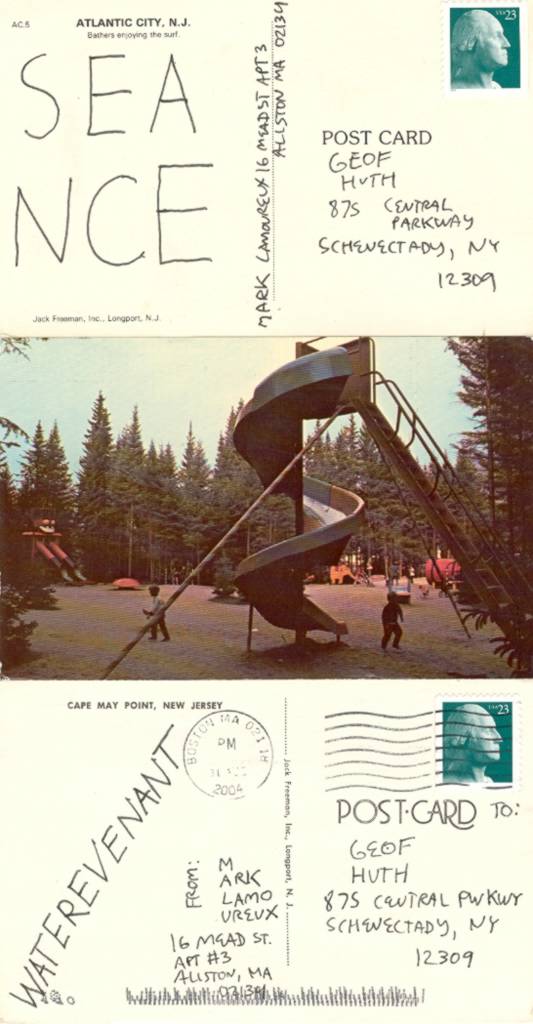
From Mark Lamoureux there arrived today three postcards, which he had told me earlier he'd uncovered at his mother's house. Each card is of an East Coast tourist venue (Atlantic City, Cape May [New Jersey], and Santa's Village [Jefferson, New Hampshire]) and carries upon its back a single punning response to the card's obverse. My favorite is "SEA/NCE," which helps us redefine Atlantic City.


Three Postcards from Mark Lamoureux (31 Aug 2004)


The Man from Conneaut Lake, Pennsylvania

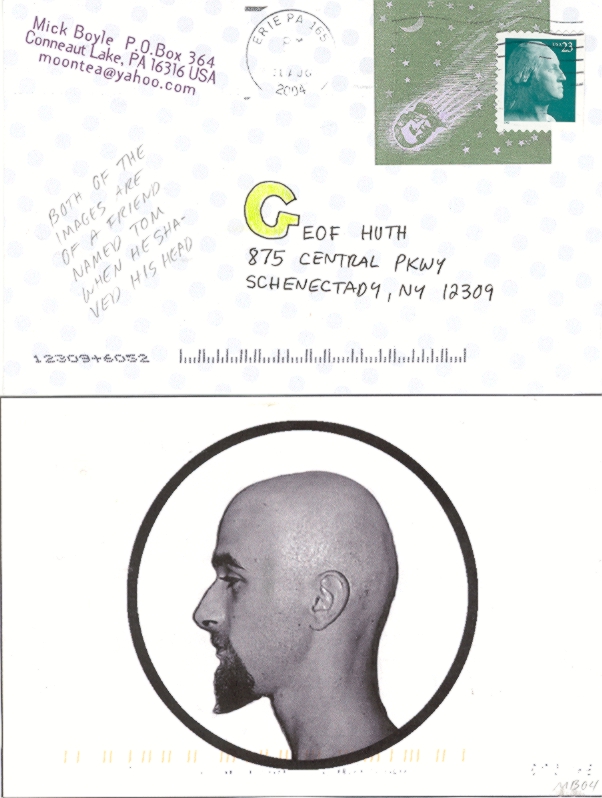
Mick Boyle sends me two cards: one reporting that he has found this website and liked the documentary aspect of it. The cards are nearly identical on the front (just different in color) and quite nicely designed. The backs provide two different views of his friend Tom after he has shaved his head.


Two Postcards from Mick Boyle (31 Aug 2004)

un violon d'ingres