Tuesday, November 16, 2004

Fulcrum-Triangle-Heart-Diamond Thought

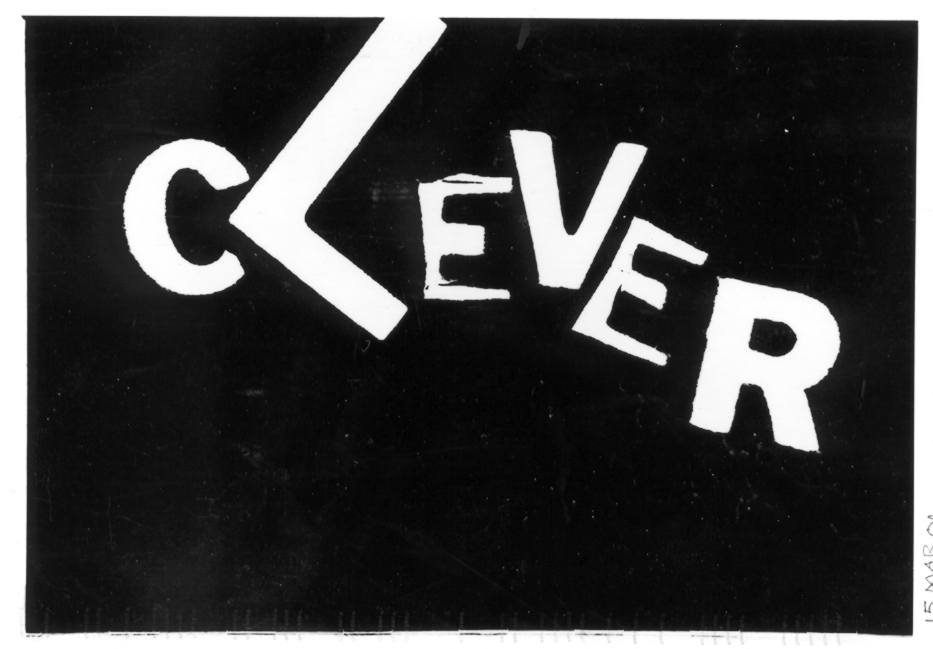
I hesitate to say anything about this card--it is such a perfect intellectual whole by itself that any commentary by me could ruin it. So find both sides of his postcard below.

It is hard, however, to avoid a few simple comments. Roy is still mulling over my micro-essay, "Collards and Poetry." This is card # 455 p/c (a photocard, and the 455th mailing of the year). In his notes on the reverse of the card, Roy asks, "Does this genre [visual poetry] give the mind lever-/age over the heart?" Maybe it does, but look at how Roy leverages the word "leverage" by tmetically severing it into "lever" (the center of the pun on the obverse of the card) and "age" (time, oldness, era). Then he places a red heart within a triangle within his pseudo-cancellation mark. Notice how the heart (within triangle) replicates the heart (found within a diamond shape) on the postage stamp he has chosen.

Always, as Roy Arenella always says, connect.


Roy Arenella, "cLever" (15 Mar 2004)


Roy Arenella, Note on the reverse of "cLever" (12 Nov 2004)

un violon d'ingres

3S &c.

The Illinois-based j0llyr0ger sends me an envelope created out of the index to a road atlas; decorated with the same cirrostratus fibratus stamp Roy Arenella used; and addressed to dbqp, qbdp, and Geof Hut (corrected to Geof Huth) in NY, NY--but the zipcode was perfect + 4. The most amazing thing about the address is that it's created from a spray-painted, hand-cut stencil, which gives the letters a varying haziness depending on how surely the stencil sits against the sheet at a particular spot.

j0llyr0ger writes a me a couple page letter, written to the "estimable Huth"--now, is he being funny? or did he misplace the in-?--and in his effective signature style: pseudo-quasi-eighteenth-century-pirate-brogue. A verbal delight. Within the letter, j0llyr0ger announces that μ 2.0 is in the works and that he's working on a new micro-periodical entitled MockingbirdWheel.

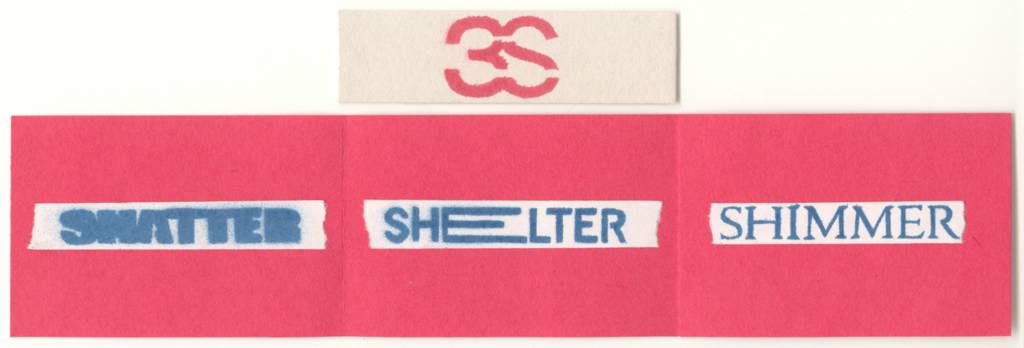
But, wonder of wonders is a little trifold publication entitled "3S," which is entirely created through stencilling and spray-painting. Three sh--er words appear on each panel of the resulting triptych, each wonderfully different visually from the rest.

j0llyr0ger, "3S" (Nov 2004)

un violon d'ingres

Monday, November 15, 2004

Why Printed Matters

What surprises, I wonder, are not hidden within the archives of Roy Arenella's home and mind?

Today, I received from him a large photocard (# 454 p/c) mailed on Veterans Day (11 Nov 2004). In the note, Roy begins by mentioning that he "hadn't realized that David Cole [the visual poet] was on Sackner's collectible list" (which is a sideways reference to a recent blog posting of mine over at dbqp). He goes on to say that he visited a quasi-retrospective of Cole's at the Montclair State University gallery a month after the man's death.

All of this reminded me that I had received only one piece of mail from Cole in my life. Cole had initiated the correspondence, and he sent a gracious introductory letter and wonderful envelope decorated in his signature stenciled style. Yet I never responded. I'm sure this arrived during the Great Darkness, those many years when I retreated from art in favor of my paying job. A great loss, the loss of a connection, but there are many others I've experienced, too many to go into here and too sad to consider.

Roy goes on to say that this card of his is a thank-you for my essay "Collards and Poetry," and for my appreciation of the rarer Royvelope.

I read this card, appreciating the fact that the pseudo-cancellation mark was filled with a stamping of a wooden device, somewhat like a wheatstalk in form, that Roy had found "in a spring flower-bed outside the gallery, at David's Montclair show." The card is finished with a 37-cent showing a cirrostratus fibratus cloud formation, a wonderful halo-like form I remember seeing only once—at Mapps College in Barbados—and an artist's stamp (I assume) of W.C. Fields. I'm not sure why W.C. is there, save that his stamp is a similar blue of the cloud stamp, but since this is a card from Roy I know there's some reason for it.

Then I turned over the card, and I was blown away. An unexpected gift: a journalistic shot of three little-known artists in the process of moving, all a smidgen out of focus—a shot taken on the run. From the left we see the famed mailartist (and rubberstamp-printing-set collector) Picasso Gaglione, the visual poet Marilyn Rosenberg, and David Cole himself! I'd never seen a picture of any of these people before, and their corporeal shapes surprised me. I never expect artists to be old. If their work seems young, my mind-picture of them is of young vibrant people. Instead, we have three maybe-sixtyish people, wrapped up to shelter themselves from the cold, but full of life. Picasso and David shake hands vigorously, and their manual embrace reaches across the face of the entire picture, holding everything together.

Wow.


Roy Arenella, "Bay Area Dada" (15 Jan 1999)

un violon d'ingres

A Fauxvelope from the Back Hamlet

Today, I received my first piece of mail from Jcsyntheticsuk of Ipswich, Suffolk, and he deftly reminds me that mailartists have their own style, that the joy of mailart is the surprise at being introduced to a new way of doing things.

The envelope of this mailing is a sheet folded into thirds, taped shut, and decorated with lines to resemble an envelope. He sketches out, for instance, the flat V of premlip on the back, above the two rising lines of the underlip. Supporting the understory of this fauxvelope are two other sheets of paper, each showing some weirdly abstract-realistic rendition of architectural space.

Within the folds of this all, we find a few pieces of diagonally folded paper with simple rubberstampings (. . . _ _ _ . . . [SOS], an arrow identified as "GOOD," and a square asterisk), a mailart call, and some cards announcing Jsuk's recentish move.


Jcsyntheticsuk, "JCS@92" (2004)

un violon d'ingres

Today's Card from Fike

While plowing through the day's mail (which I believe included five credit card offers), I saw a small postcard on the table, message side up. Inexplicably, I recognized the handwriting but could not identify the author. I made a guess I knew was wrong, then picked up the card and discovered it was from Ficus strangulensis. It has occurred to me that I may not have recognized it as Fike's merely because I haven't in a while received a Fikean postcard sent out on its own into the world.

Fike talks a bit about his health and points out that I've been using the wrong zipcode (AKA postal code) for him on the opposite side of a view of "ANT PAN recently," the blue-green cousin of what I called "Billion" below.


Ficus strangulensis, "ANT PAN recently" (5 Nov 2004)

un violon d'ingres

Sunday, November 14, 2004

Important News from the Institute for Further Details at the Design

On November ninth, j0llyr0ger sent me an original collage on a postcard. I'm always amazed when people send me their only copy of something, and I'm even more surprised when (time after time) the glued-on pieces of collages come through the postal system unscathed.

This collage is a great example of the now-little-seen ransom-note style of collage. The opening I find quite exciting, and the item of response time continues through the collage in its nonlinear way. j0llyr0ger's message tells me that this is hardcore guerrilla mailart and ends with the biblical (or Jackson MacLovian)

IT IS THIS IT IS


j0llyr0ger, "The Institute for further details at the Design"
(9 Nov 2004)

un violon d'ingres

Send Not to Sender

Roy Arenella somehow surprises me again. This time with a postcard on thick card that is nothing more than the crossed-out return address from a package he had recently received from France. This simple and common image of a return address throws Roy into another discussion on correspondence, which is one of the prominent features of his mailart. With Roy, the message he writes on the card is as much the art as the images that accompany it.

Upon seeing this return address, Roy writes,

Recieving a package from France, I am reminded of the European postal practice of crossing out the name of the sender of such mail. Each time I see this I read the same moral lesson it it—one that's cautionary, even exemplary—especially for the mail art world. Certainly French postal policy isnt concerned with ego psychology, modesty or personal pushiness. The rule that asks the sender to cross out & thsu subordinate his or her name in favor of the reciepient's is a practical one aimed at a quiker more efficient reading of the mails destination. I find in that policy a chastening effect, a needed reminder that we mail for a reason beyon only a proclaiming of ourselves. We mail to read another communicant—: the recipient.

I needn't add anything else on the subject. However, this card, mailed on 6 Nov 2004, is numbered 453C. It is a rare C (card), instead of p/c (photo/card). The stamp chosen for the card is of cirrus radiatus, a particularly visually pleasing cloud formation, which Roy sends to us on its side. Most importantly, the pseudo-cancellation mark includes a rubberstamping of a lower-case i, with its tittle slightly off to the right. This single letter deftly reiterates the card's message and illustration.


Roy Arenella, "Mail from France" (6 Nov 2004)

un violon d'ingres

John Wayne Nameograph, Jr.

On November sixth, kiyotei sent me a "John Wayne, American, 1907-1979," postcard. The image on the card is of John Wayne in western garb on a US 37-cent stamp released (apparently, though it's news to me) in 2004. On the back of the card is a wonderful nameograph that looks as if it might have been Gocco-printed. This little wrawing led me to write a micro-essay about nameographs elsewhere, so no need to go into any more details here!


kiyotei, "John Wayne" (6 Nov 2004)

un violon d'ingres

Fike is Back

On the fourth of November, Ficus strangulensis mailed me another envelope announcing that he is back, which is great to hear. His note, unexpectedly, centers around guns: about reuniting with his shooting buddy after a month away, that one of my fidgetglyphs looks like a "hand-blunderbus[s] discharging," and the news of a shooting death of someone he knew.

But the rest of the envelope is everything we'd expect from Fike (not that talk of shooting ain't!): the normal craziness on the envelope (including Fike's own phizzog on the address label), two painted cards, one color card rewriting a John M. Bennett poem, and a beautiful hyper-reworked collage, which we see below.


Ficus strangulensis, "Billion" (2004)

un violon d'ingres

Saturday, November 13, 2004

Reading Reed

Large mailings from Reed Altemus arrive wrapped in brown paper.

This one came with a letter from Reed. In it, he talks about going to New York and meeting Mark Bloch (the Panman), whom I haven't had any contact with in years.

The rest of the package consists of a sheet of 42 numbered Postflux Fluxpost artist's stamps (identical save for the identifying numbers upon them) and a sheaf of stapled pages entitled "Eight Event Scores." These are wonderful scripts for happenings and range from the humorous

Fruit Event


In your car on the way to work, hold a banana up to your ear and talk into it

Conduct crucial business using the banana

Make important business decisions usng the banana

Call your girlfirend or boyfriend and make arrangements for a weekend getaway in the Poconos Mountains using the banana

Check the messages on your answering machine using the banana

Call the office and tell them you're going to be a little late today using the banana

Etc.

to the Zen


Opus 6


Make no plan


to the impossible


Fluxyoga


Nose to navel – 1 minute

Elbow to chin – 1 minute

Knee to small of back – 1 minute

Big toe to opposite shoulder – 1 minute

Ah, if only!


Reed Altemus, Cover of "Eight Event Scores" (2004?)

un violon d'ingres

Tuesday, November 09, 2004

the all-seeing eye becomes (qbdp # 37)

Hampton Inn, Room 115, Williamsville, New York

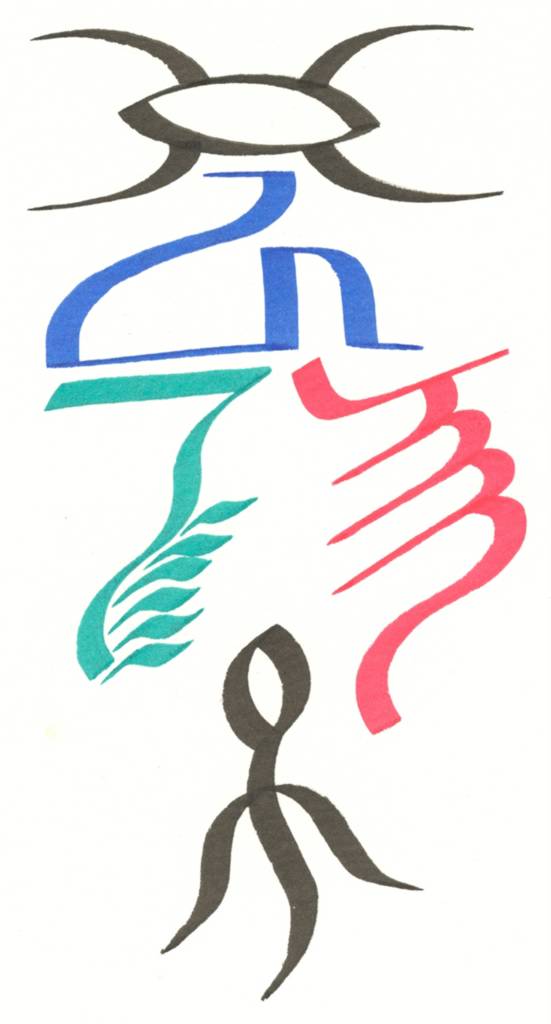
Another night in a hotel room, away from home, and I still have to prepare to give a presentation on document imaging tomorrow. But first I had to create a new mailing. It's been a little while since my last overnight (a couple weeks?), so I have many people to repay with a mailing. Also, I wanted some heft to the visual poem this time, so using my thick art markers I created a four-color asemic fidgetglyph that I call "the all-seeing eye becomes."


Geof Huth, "the all-seeing eye becomes" (9 Nov 2004)

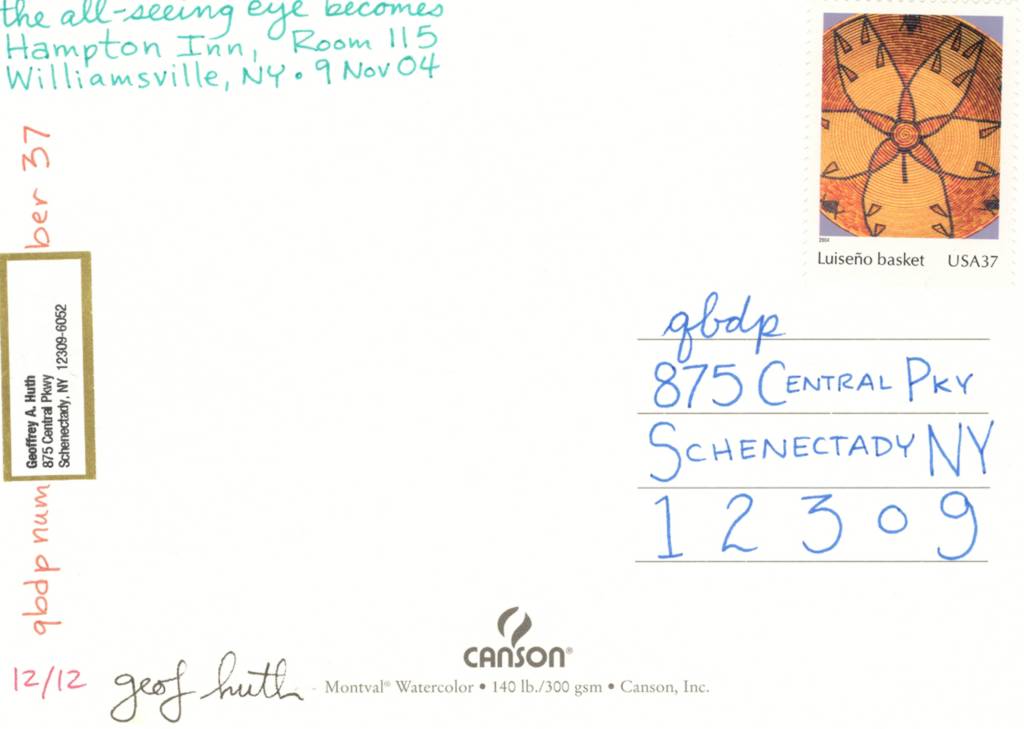
I've inscribed each glyph upon a large, thick, blank postcard (Canson Montval, 140 lb/300 gsm), and sometime later tonight I'll write each correspondent a note. Each card sent to a correspondent in the US is completed with a stamp form the "Art of the American Indian series." These stamps are huge and colorful and sit on the back of the card along with blue, green, black, red, and reddish-brown inks.


Geof Huth, Reverse of "the all-seeing eye becomes" (9 Nov 2004)

The lucky recipients of this mailing are as follows:

1/12 Ruth and Marvin Sackner

2/12 Bob Grumman

3/12 Roy Arenella

4/12 kiyotei

5/12 Mick Boyle

6/12 Qpidoremix

7/12 Reed Altemus

8/12 Scott McDonald

9/12 Ficus strangulensis

10/12 Scott Helmes

11/12 Erin Huth

12/12 qbdp

un violon d'ingres

Monday, November 08, 2004

The Fourth Coaster

Four months ago, kiyotei mailed me four decorated postcards, and three of them arrived. In a big surprise, the fourth arrived last week taped to an envelope. I was amazed and pleased. Given that this is the fourth card, rather than show the decorative reverse, I decided to show the obverse--just how kiyotei prepared these for mailing and how he added a note to each coaster!


kiyotei, The Fourth Coaster (Jul 2004)

un violon d'ingres

The Inestimable Fruitfulness of the dbqpnacci Sequence

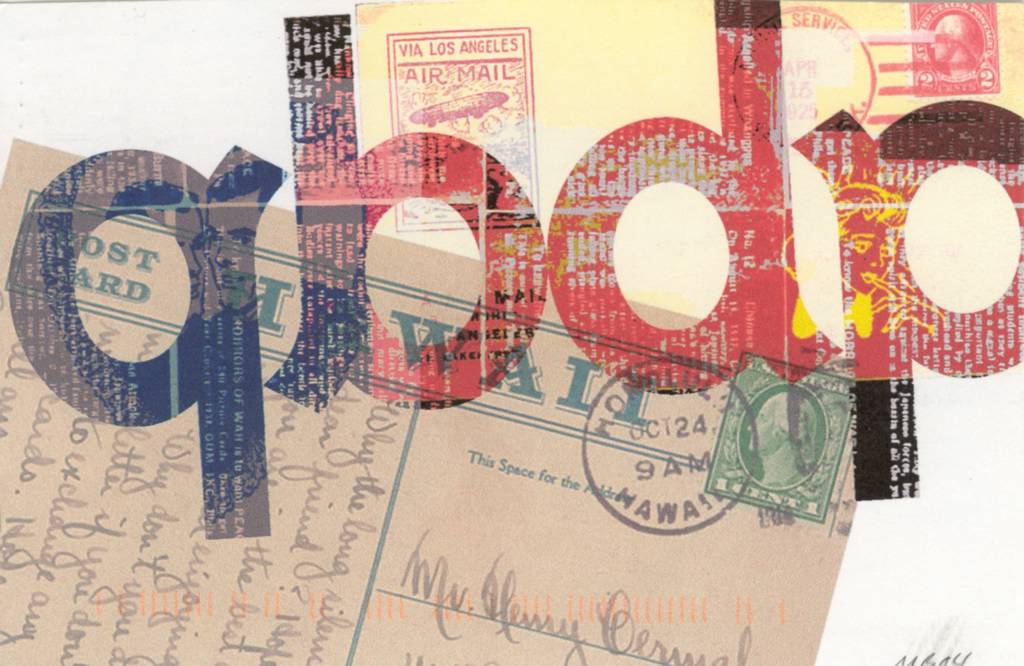
Somehow, Mick Boyle has been able to produce his most beautiful meditation on the dbqpnacci sequence so far. I am stunned by the beauty of it and believe I should make this the logo for this site!


Mick Boyle, Another "qbdp" (30 Oct 2004)

un violon d'ingres

Hoy Día, Muerto

Anticipating Halloween and memorializing the beheadings rampant in Iraq, Roy sends this powerful, morbid card. On the obverse, he has decorated it with a rubberstamping of a skull and a ten-cent "Legend of Sleeping Hollow" stamp (the latter recalling both Halloween and beheadings!). This is card # 444 for the year.


Roy Arenella, "Happy Halloween" (25 Oct 2004)

un violon d'ingres

QED: QSL

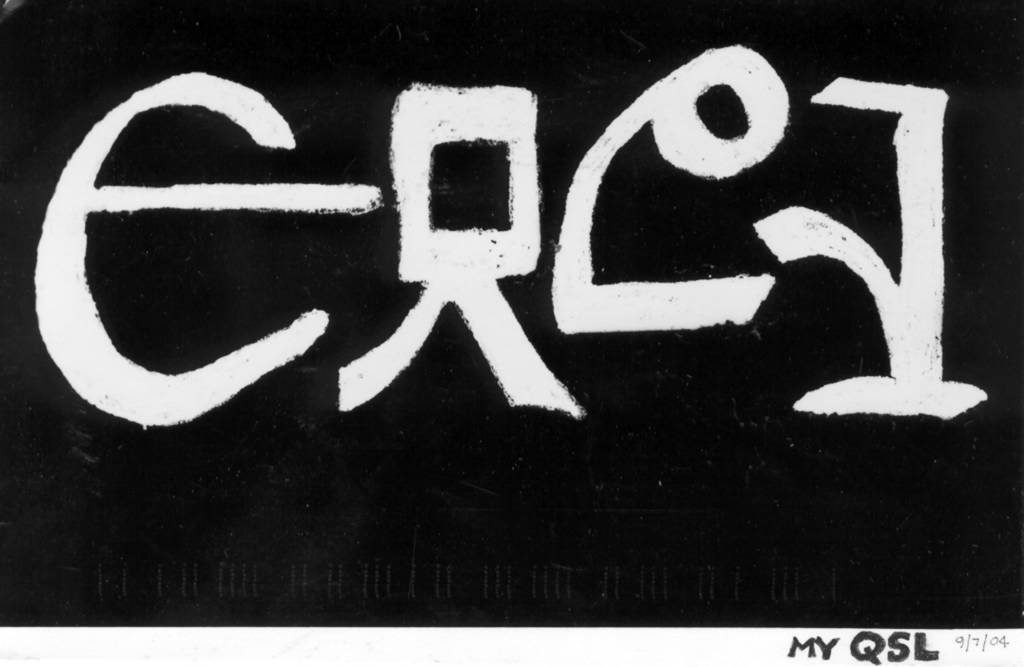
Roy follows up his royvelope discussing QSL cards as documental structures with his own quasi-QSL card, an asemic calling card (mailing #442 for his year).


Roy Arenella, "My QSL" (7 Sep 2004)

un violon d'ingres

The Art of the Royvelope

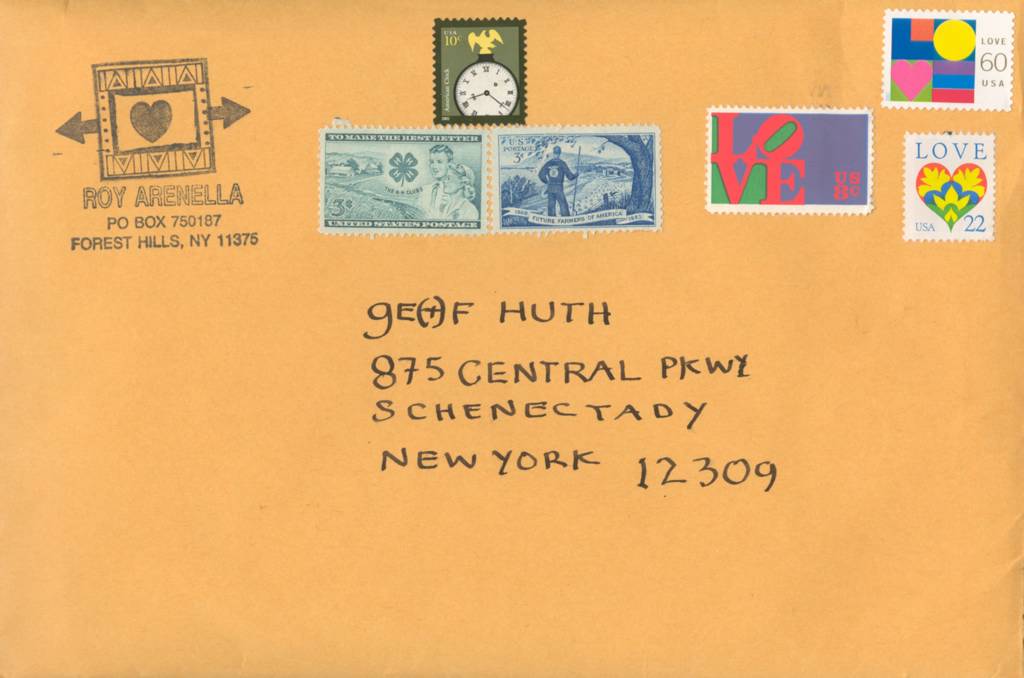
Roy Arenella usually sends me examples of his photo/cards in the mail, so I see his enveloped art less frequently, so let us now praise royvelopes by admiring their features:

Postage stamps

Roy collects mint stamps, so that he has a good collection of emotive and expressive stamps to use, enough stamps for any situation. On this page, Roy includes three "LOVE" stamps, including the classic Robert Indiana eight-cent. Why? Because a central feature of the royvelope is

Back-reference

Roy is constantly referring back to letters of mine, cards of mine, or--most frequently--blog entries of mine. The three "LOVE" stamps are his message to me that he read my brief entry on the most famous visual poem ever.

Handprinting

Roy always handprints the addresses on his envelopes. His hand is simple, yet solid. There is an ineffable innocent quality to the hand, one I can't quite put into words, but one that I always find endearing. The hand defines the man.

Rubberstamping

The royvelope usually includes some piece of rubberstamp printing. In this case, the stamping is a heart, a re-reference back to the visual poem, "LOVE."

Contents

Just as an envelope is a carrier of information, a royvelope is a carrier of art. This envelope includes a letter that focuses on my blog entry that discusses "documental structure." This was an entry from September, and Roy has been thinking about it for a while and suggests a couple other such structures that visual poems can emulate: "cattle brand marks & ham radio QSL cards" (the latter being ham radio operators' calling cards). Roy then fills the envelope with examples and musings, color xeroxes, handwriting in marker and pencil, newspaper clippings, and on. But there is no chaos to the contents; Roy has arranged them thematically.

It is an honor to receive such gifts of insight and art.


Roy Arenella, [A Classic Royvelope] (23 Oct 2004)

un violon d'ingres

Postcard as Machine

Qpidoremix's first mailing to me arrived second, and it's almost a miracle it made it here. What he has done is create a chambered postcard through which I was supposed to send two Euro cents. Unfortunately, the cards workings came apart and some postal service packaged the entire machine in a sealed plastic bag.

I haven't opened the bag, assuming that it is a better artwork if I never actually touch it. And none of the pieces appear to have been lost, even the two cents, escaped from their tissue paper holsters, are still rattling within the bag with the wooden framing of the card.

Interestingly, today I mailed my daughter Erin (who's living in Dublin) a bunch of earring backs and posts, so she can make earrings out of Euro cents. She has enough supplies for 24 earrings!


Qpidoremix, "P-Chi" (Oct 2004)


Qpidoremix, "P-Chi," Reverse (Oct 2004)


un violon d'ingres

Wednesday, October 27, 2004

Clunar Ellipse (qbdp # 36)

Southgate Tower, Room 1221, New York, New York

At the end of tonight, half-dead with weariness, I created a small fidgetglyph (and affixed it to a set of postcards) to memorialize the full lunar eclipse I could see from my window, an eclipse that turned the moon a muddy tan, so I chose I muddy red and a muddy green for the glyph.


Geof Huth, "CLUNAR ELLIPSE" (27 Oct 2004)

These are the people who received copies of "CLUNAR ELLIPSE":

1/10 Ruth and Marvin Sackner

2/10 Bob Grumman

3/10 Roy Arenella

4/10 Scott McDonald

5/10 Qpidoremix

6/10 Mick Boyle

7/10 Michael Leigh

8/10 Erin Huth

9/10 Dees Stribling

10/10 qbdp
un violon d'ingres

Tuesday, October 26, 2004

Four for Fall

My wife, the inestimable Nancy Huth, onetime teacher of the year in Schenectady, wonder of wonders, woman of my life, decided that she would include a mailart unit in her creative writing class! She taught--imagine that: taught!--her class mailart, and she gave her students the assignment to create a piece of mailart on the theme of fall.

So we had a little mailart project going on in our house, with a twist. Nancy didn't want to make her students pay for the postage to mail out the cards, yet she knew that the mailing of the cards was essential to making this mailart, so we added the postage ourselves, and from Albany I mailed the art back to us in Schenectady. Over two days last week, all the pieces arrived safely back home.

I've decided to document a little bit of this mailart show tonight, and I'm pleased at the breadth of imagination exhibited by these young minds.


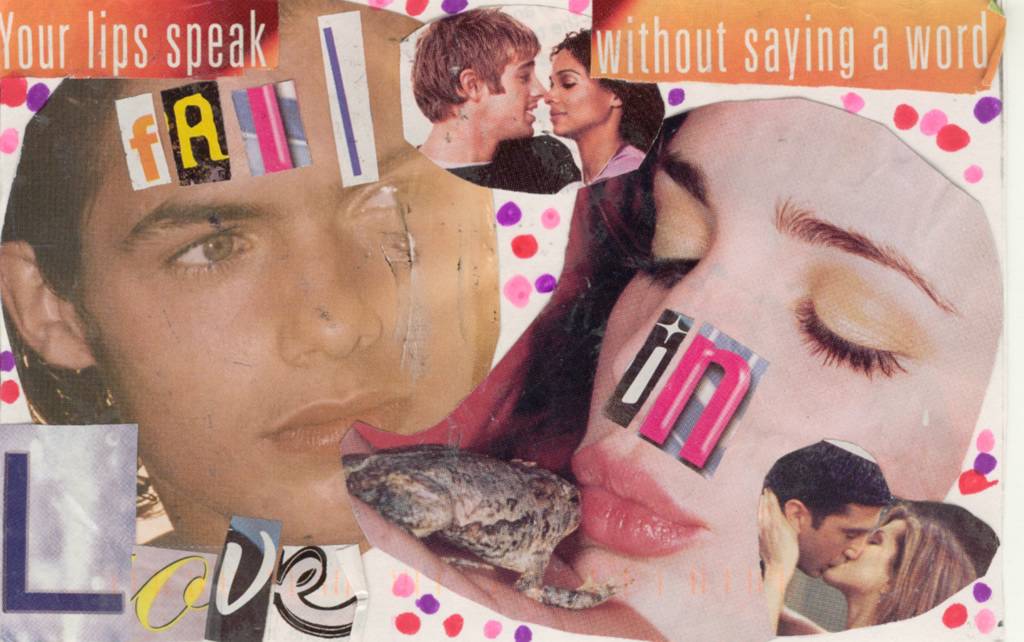
Imbody's "Your lips speak" (Oct 2004)

Imbody has done a great job putting together a girl-centered postcard collage. She glues together many little bits from glossy magazines to present us a kaleidoscopic look at fall love. The obverse of the card includes a little poem, a bit of collage, multiple magic-markered dots, and little rhinestones glued to the page. Amazingly, all of these made it through the mails to our mailbox.


Kirkham, "Fall Fashions" (Oct 2004)

Kirkham, creator of "Fall Fashions," decided to make her "postcard the shape of a leaf, and on the other side fall fashions." She surprises us by drawing a connection between the natural process of autumn and the cultural process of fall fashions.


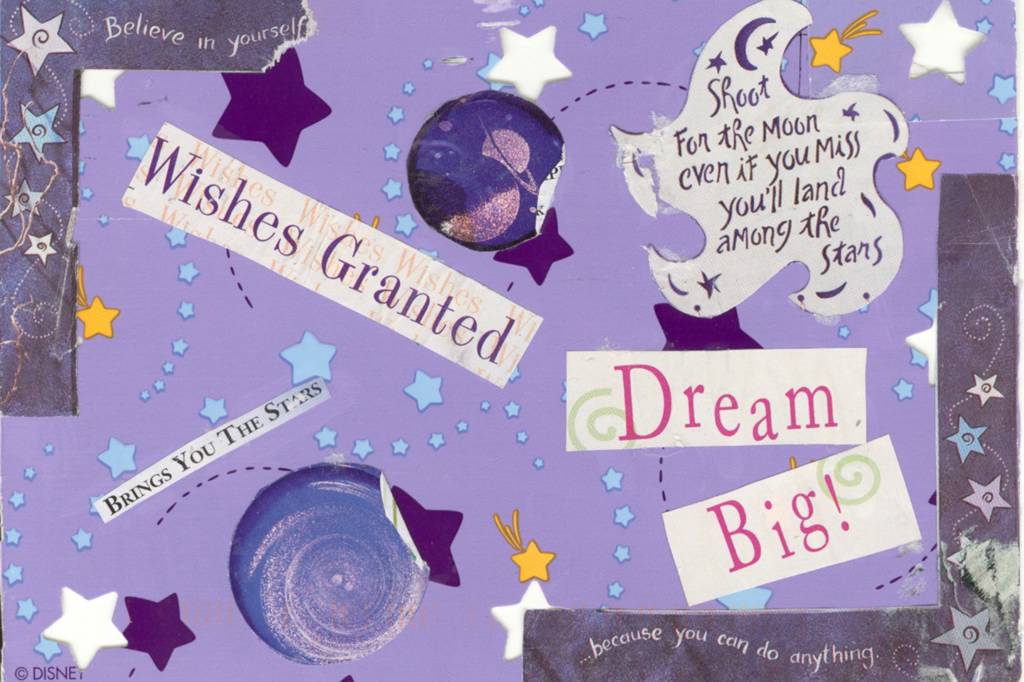
Lupo's "Wishes Granted" (Oct 2004)

Lupo begins with a postcard of a waterslide, then she punches stars out of it and collages over it, creating a multi-dimensional feel to this simple card: A beautiful design that holds together quite well. On the obverse, she explains, "When I heard the word 'fall' I thought of falling stars and dreams so that's how I came up with this idea."


Tallman's "happy fall!" (Oct 2004)

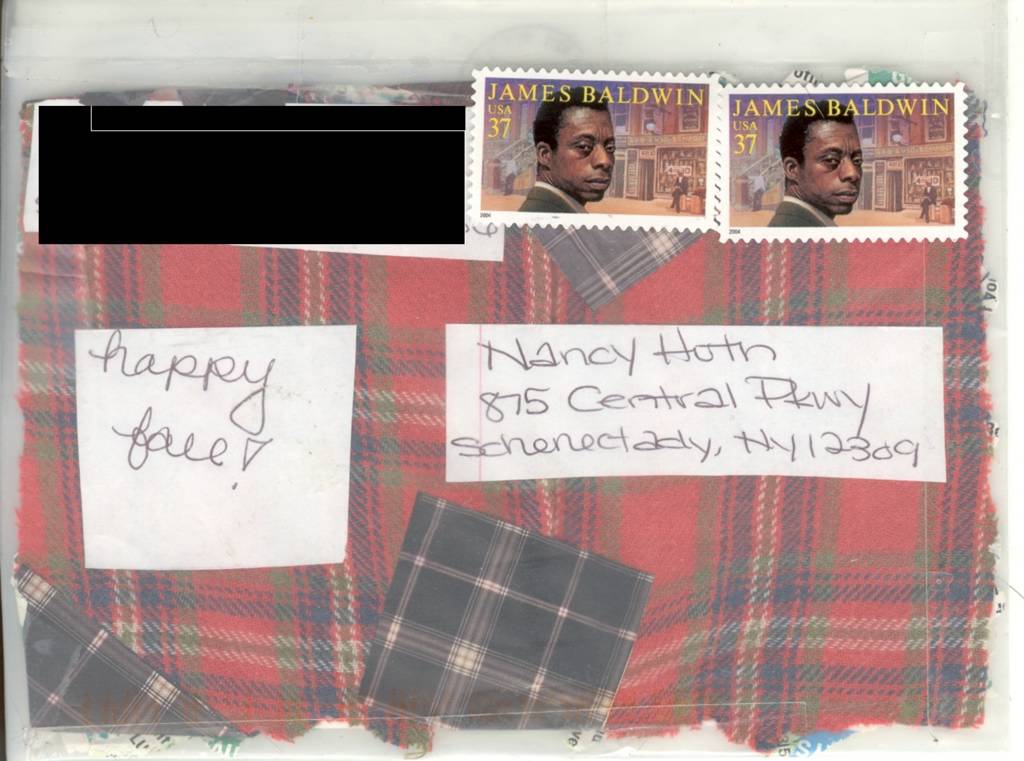
Tallman's card is quite a production. The side you see here she created from a swatch of plaid cloth, upon which she collaged pictures of plaid! On the reverse is a remarkable collage of torn pieces of paper piled on top of one another. Some of the collage (faux hair) is glued or taped down only partially, allowing the hair to blow in the breeze. This card was so delicate that I had to package it in a transparent bag before mailing it back to us.

And that is a brief rundown of part of Schenectady High School's first mailart show!
un violon d'ingres

McDonald's Old Cards

Scott McDonald has sent me yet another recycled postal card. These are remarkable bits of ephemera. He takes a postal card that someone has already written upon and mailed, then he turns the card upside-down, literally, to add a new set of addresses. (I'm amazed that the postal service gets these double-addressed cards to my home without incident.)


Scott McDonald, "nonsense v 2.1" (22 Oct 2004)

The card I received this week (entitled "nonsense v 2.1") includes a message written 1 Jan 1943 by Mettie of Cape Cod who wishes her friend Ralph Giles of East Baldwin, Maine, a happy new year. Over Mettie's dark dramatic hand, Scott has typed in red a bit of wonderful (yet difficult to read) nonsense.

What could be better?

un violon d'ingres

Saturday, October 23, 2004

Arses and Sequences

Michael's Arses

Yesterday, I received a couple of cards, the first from long-time mailartist, Michael Leigh. He sends a very humorous and Pythonesque (or Gilliamesque) postcard. The image on this postcard is his own, apparently printed for free by boomerang ("the UK's leading lifestyle and youth media solutions company"--making me wonder how many companies meeting this description exist in that country). The company distributes this and other cards by students "around hundreds of universities all over the UK."


Michael Leigh, "The Arses of Scotland"
from The Beautiful Britain Series (2004?)

But Michael didn't send me his address. I think I have his old London address somewhere, but that's it. So, Michael, send details of your whereabouts.


Boyle and the dbqpnacci Sequence

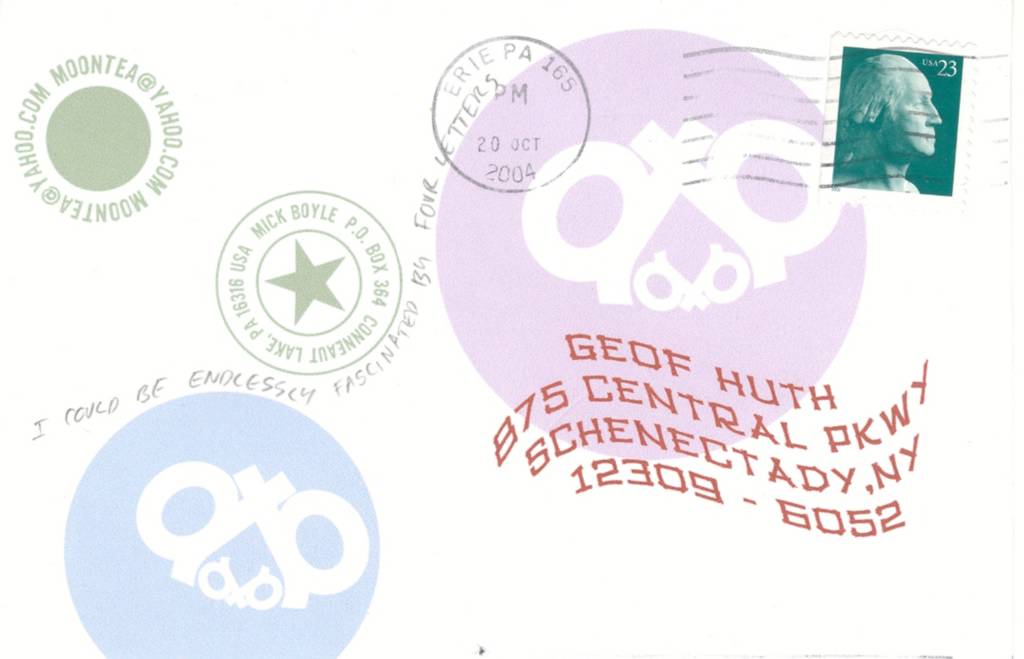
Mick Boyle continues to experiment with the possibilities of the dbqpnacci sequence, and he reports (in a curvilinear note), "I could be endlessly facinated by four letters." On the obverse, Mick fiddles with "dbqp," allowing the ascenders of the large d and b and the descenders of the small q and p to cross, suggesting almost a human face.


Mick Boyle, "dbqp" (postcard's obverse, 20 Oct 2004)

On the obverse, we find a blue young man, who is sporting the popular qbdp tattoo on his right arm. But look behind him: that swirling lacy pattern is actually created from qbdp and dpqb repeated and linked together.


Mick Boyle, "qbdp" (postcard's reverse, 20 Oct 2004)

un violon d'ingres

Sunday, October 17, 2004

Pay Close Attention

Yesterday, I posted descriptions of all the accumulated mailart I've received over the past few weeks, and today I added any missing illustrations to all those posts. So there are ten posts from yesterday for my readers to enjoy. They might take a little while to review, but you'll thank yourself afterwards.

un violon d'ingres

Saturday, October 16, 2004

Roy Arenella in Love

Finally catching up with my mail, I arrive at the one card I received today: "Rest Your Heart" by Roy Arenella.

Roy is one of the observant of mailartists in my coterie, and a man who is always responding to me in beautiful and surprising ways. A few days ago, I wrote a small blog entry arguing that Robert Indiana's "LOVE" is the most famous visual poem of all times.

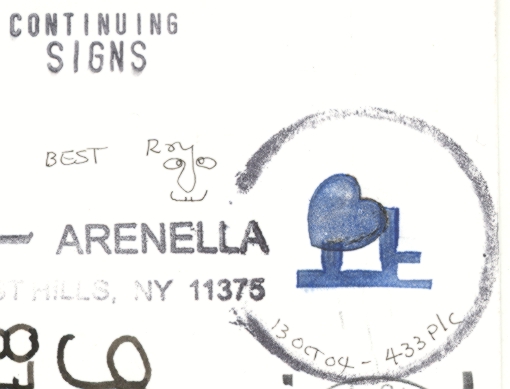
The next day, Roy mailed me this photocard, which is from his "Continuing Signs" series. On the reverse of the card, he writes, "This one for "gE(•)F."


Roy Arenella, "Rest Your Heart" (31 Jul 2004)

This photo gracing the front of the card is a delicate collection of greys. Roy is a real photographer, and he takes stunning pictures of the most simple tableaux: in this case, a spray-painted and stenciled message ("REST YOUR HEART") on the girder of a railway trestle in Montpelier, Vermont. Roy's photocards are actual original photographs that he prints himself, and they are usually (as in this case) bordered in a graceful black.

The message of this photograph refers back to my essayette without ever mentioning it. If I wondered for a second about, if I ever questioned, Roy's motives, then the beautiful blue stamping (which rests within his pseudo-cancellation on the reverse of the card) would definitely convince me. Roy has created a semiotic poem that echoes Indiana's "LOVE." Various perpendicular lines represent, though just barely, the L and the E of the poem. But, most wonderfully of all, a slightly askew heart (♥) rests within this armature and serves (appropriately) the role of both the O and the V.


Roy Arenella, [Heartshaped LOVE] (13 Oct 2004)

Strangely, Roy didn't use a "LOVE" postage stamp to maximaphilatelize this card, probably because he didn't have one handy. Instead, we have a 20-cent stamp commemorating two centuries of US-Netherlandish relations and a 3-cent stamp remembering the 150th anniversary of the Pennsylvania Academy of the Fine Arts. This card is numbered 433P/C (a photocard, and the 433rd mailing of the year).

The quietest mailing of all hits me, again, the hardest.

un violon d'ingres

The Maine Man

This week, I received from Reed Altemus yet another stylish neo-fluxus envelope. His mailings are among the most precise and quietly beautiful that I receive.

The envelope is a larger one in his usual tan (not the common orange) and it is decorated with a few rubberstampings in brown: an INTERNATIONAL POSTAL ART STAR pseudo-cancellation (complete with a hammer and sickle), a Post Flux Flux Post crossroads stamping, and a quizzical stamping of a strangely mammalian beetle hunkered down, staring at us, and with its rearend and wings pointing up into the air.


Reed Altemus, [October's Envelope] (Oct 2004)

This time, the contents of the envelope are simple:

A thermoprinted card (with raised lettering): EVERYTHING THAT IS PRINTED IS GOOD (Dieter Roth)

"Another Postal Surrealist Freakout Poem" with a weirdly indistinct cover I quite like that includes bits of an advertisement for "The world's most / Comfortable Chair."
un violon d'ingres

Dutch Puns and Visual Poetry

I think Qpidoremix, a mailartist from the Netherlands, posted this mailing to me on 6 Oct 2004, since the only numeral I can interpret in the postmark is a "6."

Inside the envelope is a sheet of paper, with a letter on one side, covered with photographs, and laminated into one single piece. (As an archivist, I must point out that we do not support lamination as a preservation method. Encapsulation, interleaving a sheet of paper between two sheets of inert plastic, is the allowable alternative. As a mailartist, I must point out that I realize that preservation is not the main issue here; presenting a unique art experience is!)

Qpidoremix's letter discusses his Dutch poetry, which he calls "BarddraB" ("bard" meaning "bard," and "drab" meaning--instead of "drab"--"muddy goo"). He also explains the puns he uses in that poetry, and suggests I check out a site where I can find more "(dutch)(visual) poetry." The example he directs me to is a traditional pattern poem in the shape of a wineglass. Interestingly, this poem is similar in shape (and, I expect, subject) as a very famous French pattern poem. If you click on the link on the bottom of that page, you will find other poems by Qpidoremix, many of which are shaped poems.

On the other side of the sheet, Q has created a design based on the dbqpnacci sequence in the southeast quadrant. The rest of the quadrants, starting with the northwest, are photographs, which Q identifies as "Fountain of youth," "hmbrella" (great title), and "reflection."


Qpidoremix, [Quadrants] (Oct 2004)

un violon d'ingres

McDonald's October Recyclings

Scott McDonald has (or had) in his possession a number of used postal cards (the USPS's term for a postcard printed by the Postal Service complete with postage). He has slowly been recycling and redistributing these 1-cent cards as a form of mailart.

Votatile

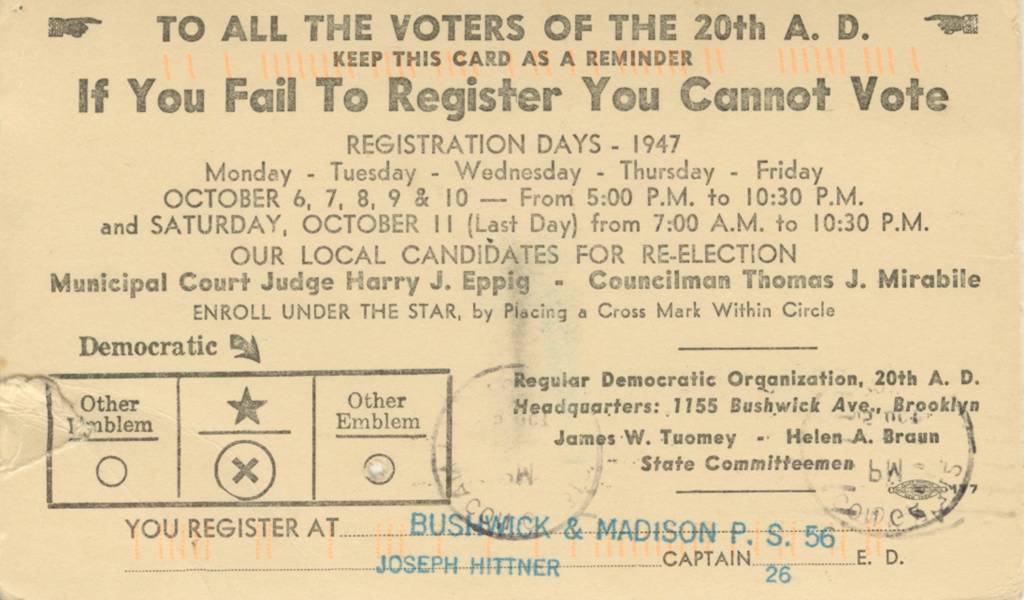
Scott is, apparently, thinking of elections (the 2000 elections, with vote-counting questions in Florida, and our current presidential election about to occur). Originally, this card was mailed to Katherine Praetz of Brooklyn, New York, on 2 October 1943. Sixty-one years and three days later, Scott turned the card upside-down and addressed and mailed it to me. The card, originally mailed out by the Democratic party, urged Katherine (of the 20th assembly district) to register to vote by October 11th, and the card explains precisely how and where and when to do this. Scott, mimicking the punchcard voting system of parts of 2000 Florida, punctured the card, as if voting himself.


Scott McDonald, [Voting Registration Reminder] (5 Oct 2004)

Lou Reed, Haiku

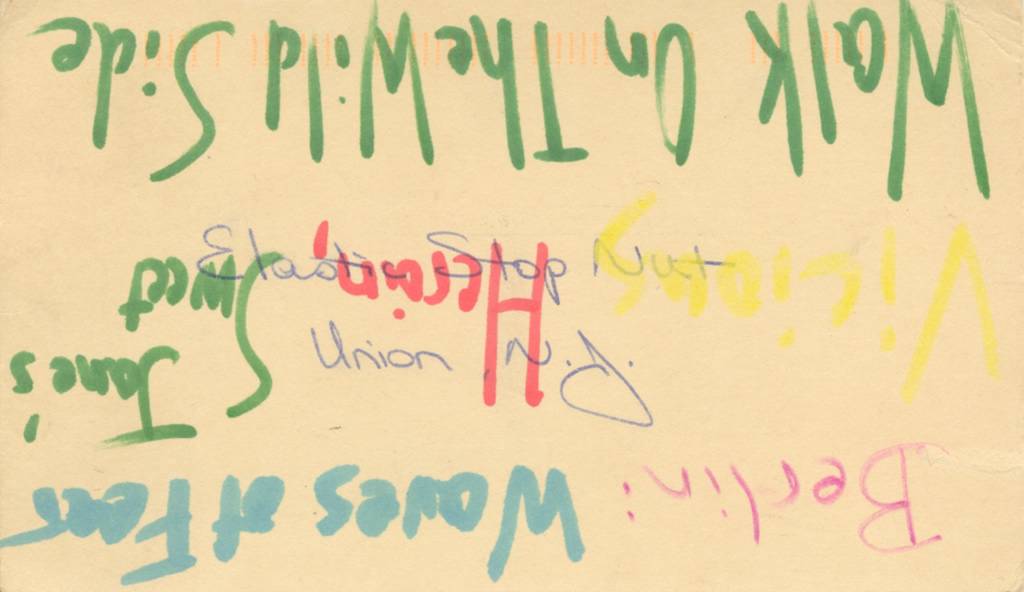
Scott's other recycling is a card mailed to Mrs. J. M. Leonard (of New York, New York) from Plainfield, New Jersey, on 13 February 1943, with this most quizzical message:
Elastic Stop Nut
Union, N.J.
Over this message, Scott has written (in purple, blue, yellow, red, and green) a "haiku" created out of titles of songs from Lou Reed's solo career and his career with the Velvet Underground:

Berlin: Waves of Fear
Vicious, Heroin, Sweet Jane's
Walk on the Wild Side

Scott McDonald, "Elastic Stop Nut"/Reed Haiku (Oct 2004)

un violon d'ingres

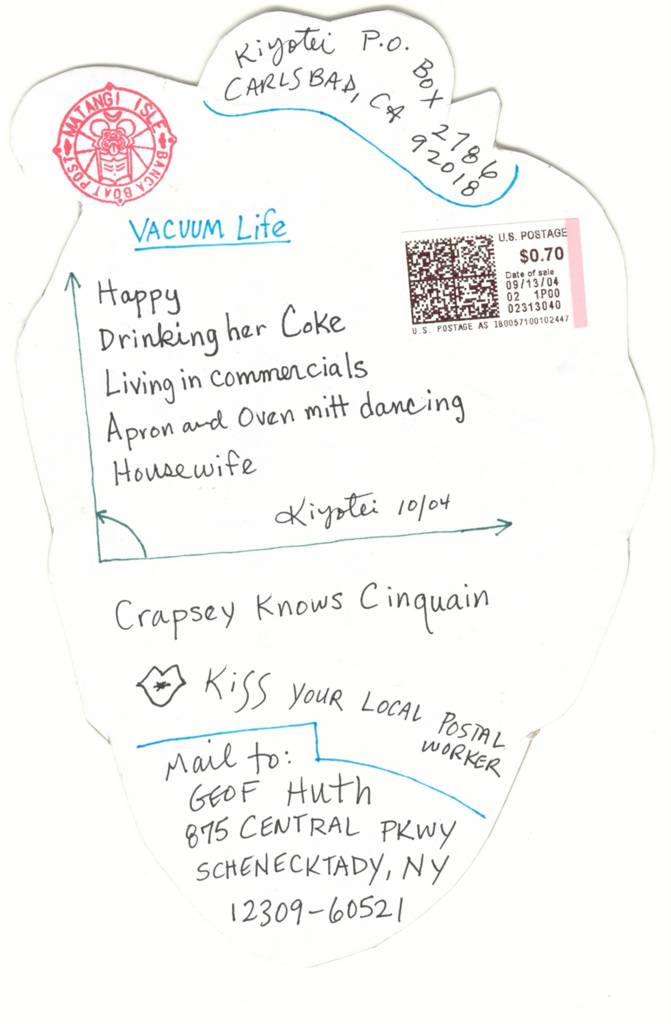
Matangi Isle Post Lucy Housewife Cinquain

So cruel am I to my readers that I am depriving you of the obverse of this card, which is the heavily pixellated face of a young Lucy Ricardo (Lucille Ball), her hair up in the manner of a 1950s housewife, with her lips a shocking red and green eyeshadow lurking over her peepers. This is such a stunning image and remarkable mailing that my wife took this to her high school creative writing class for a short mailart unit. (Sometime soon, I will have to report on the results of that unit, but not until the kids' mailart flows into our home.)

This card is another surprise from kiyotei, who experiments with methods of creation and forms of work all the time. Even given his past surprises, I was amazed that kiyotei created this piece. He took the image of Lucille Ball as housewife and created a cinquain about housework on the back. Not only that, though: he also made a reference to Adelaide Crapsey, a minor poet most famous for creating the cinquain, an American form based on the "syllable"-count Japanese poetic forms (haiku and tanka).

kiyotei writes a poem using the original cinquain form (a 2-4-6-8-2 syllable count that somehow always reminds me of the shape of the Shakespearean sonnet). The form most people learn is a weird and deadly transmogrification created by English teachers to teach kids the parts of speech. These horrible cinquains consist of five word-counted lines in this pattern: one noun, two adjectives, three gerunds (AKA "verbs"), four adverbs (as I learned it), and another single noun.

If I weren't lazy right now, I'd go up to the third floor, and pull out my archives to find the cinquains I wrote in the eighth grade in Calacoto, Bolivia. But lacking that, enjoy kiyotei's work, not just the poem, but the right-angled bracket for the poem, the Matangi Isle postmark, etc.


kiyotei, "Vaccuum Life" (Oct 2004)

un violon d'ingres

Three Blue Cards from Boyle in Pennsylvania

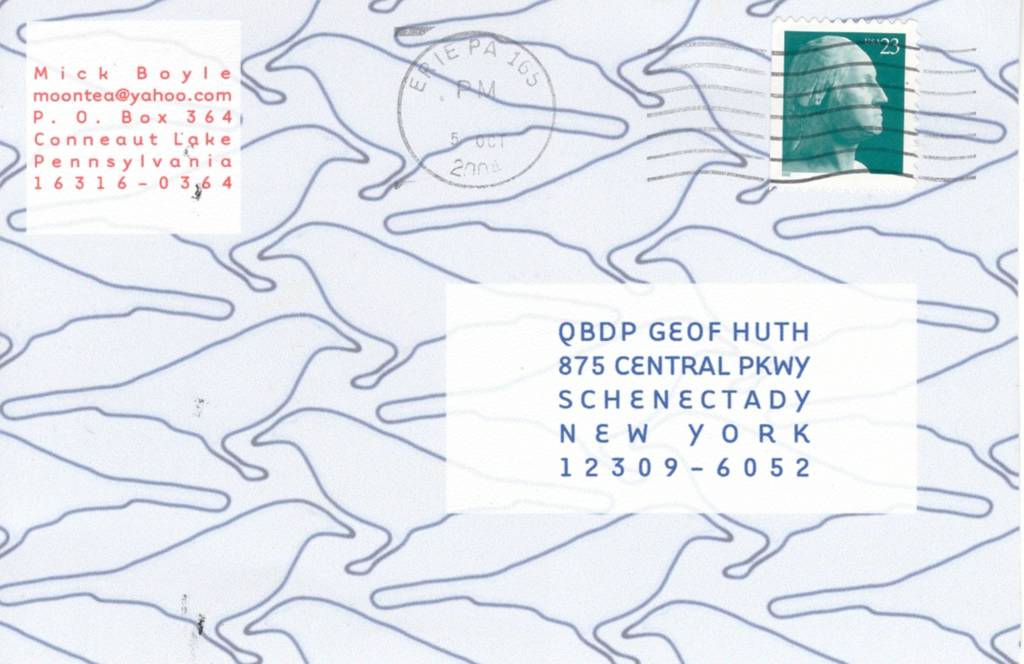
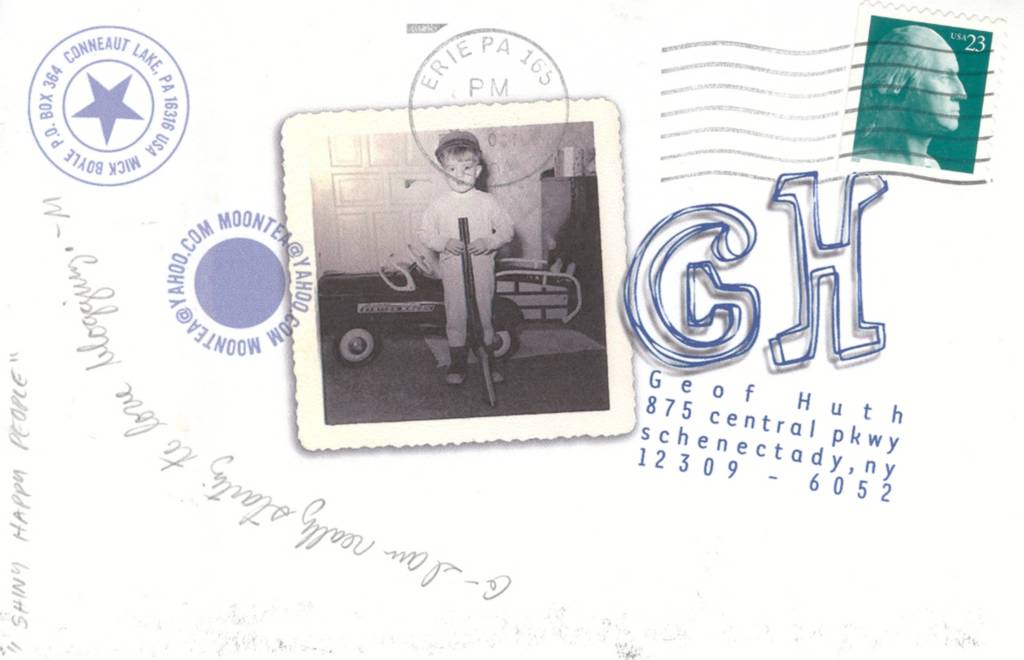
I cannot say for sure when each of these cards from Mick Boyle left Conneaut Lake, Pennsylvania, for Schenectady, New York. The first two are postmarked 5 Oct 2004, but all I can read is "Oct 2004" on the postmark from the last one. I'll treat them all as if they came to me at once, but the third arrived separately.

The first card is just another example of the fine typographic design created by Mick, who's certainly the most accomplished typographer I deal with. He has taken the blue outlines of a number of identical birds and fit them together in a pattern similar to those designed by M.C. Escher. But I also love the text: the red return address, the offsides tail of the Q in QBDP, and the inclusion of a Greek capital E in the chosen typeface.

I chose this side of the card (too lazy to do both as I try to catch up with mailart documentation) because I think the card may be presenting us bluejays, and therefore it echoes Roy Arenella's bluejaypost. But the "message" side, also presented in blue, is an interesting jigsaw of images: a tv-scan-lined images of a young man, a drawing of a pair of feet across the grain of a wood floor, a bound man with his mouth taped, and about a third of a naked man who is tattooed as "Joe" and whose left eye is barely visible to our own.


Mick Boyle, [escherbirdpatterning] (Oct 2004)

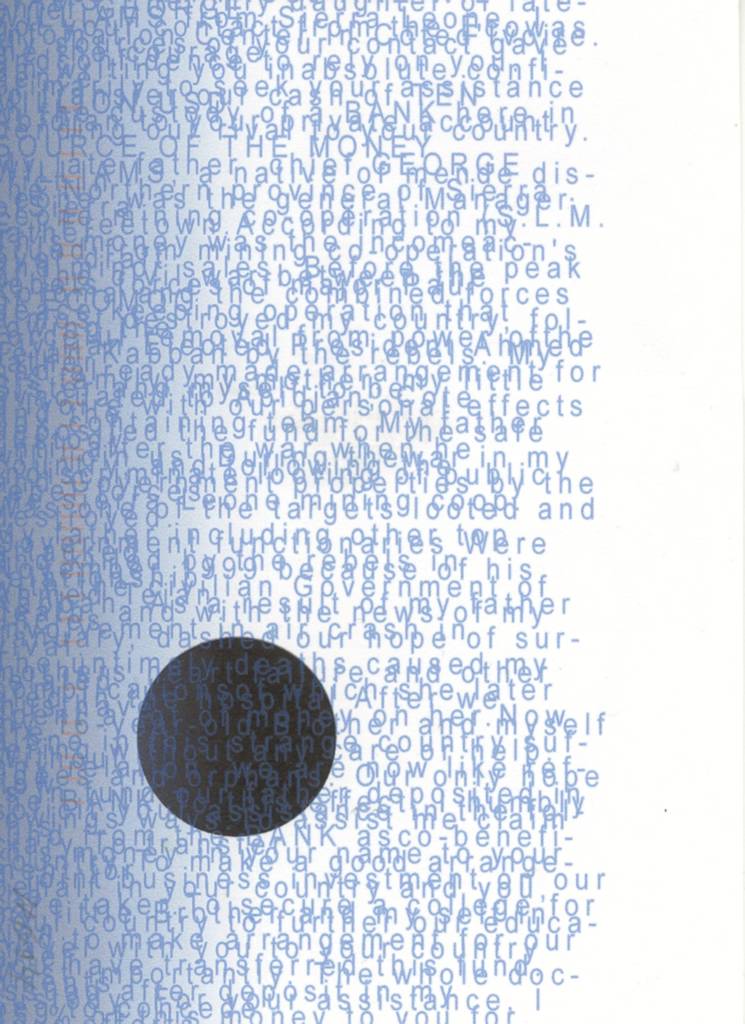
On the face of this card, Mick writes, "here is one way to deal with spam." And it is a beautiful solution to spam. I like how words suddenly jump out of the text announcing themselves before falling back into tumult.


Mick Boyle, [spamtextvisualization] (Oct 2004)

This old almost-deckle-edged snapshot is a beautiful composition, and the design I once again love. We miss, however, the "SHINY HAPPY PEOPLE" who are arguably the central subject of this card. On the reverse is a blurry close-up of three very pink and quite shiny men, who are smiling at something to the right of me.


Mick Boyle, [snapshotpostcard] (Oct 2004)

un violon d'ingres

Bluejaypost

The obverse of Roy Arenella's card (from 28 September 2004 or so) reports the blue jays were prevalent "this week" in his area of the world (Long Island, New York).

This calligraphic card is a rarity among Arenellanisms. Made up of five letters and a hollow tittle over the i, the word "biRdS" is a visual pwoermd. In some way that I cannot express, the look of each of these letters is birdlike. The S is definitely birdshaped: an avian swoop. The bellies on the b and the d suggest the carriage of a pigeon (though not quite a bluejay). The R, with its right leg swooping low and away, is a walking bird. The tittle is maybe an egg. And the b, the p-like R, and the d in a row suggest something of the bobbing of an ambulatory bird. Over the past few weeks, I've been drawn back to this imagetext, but I still cannot quite explain why. I've just tried, but I'm missing something, or much.

The side of the card includes Roy's occasionally-seen Japanese-style signature stamp. Look closely, and you will see that the stamp is not in Japanese characters of any kind. Instead, the stamp spells out "ROY" in Latin letters given a Japanese look.

This card is mailing 419C (a card and the 419th mailing of the year), and it is another maximaphilist adventure. The card concerns blue jays, the pseudo-cancellation includes a rubberstamping of a bluejay, and the card is postage stamped with a 20-cent blue jay and a 3-cent bluebird. Will wonders never cease?


Roy Arenella, "biRdS" (28 Sep 2004)

un violon d'ingres

Found Poetry from Belgium

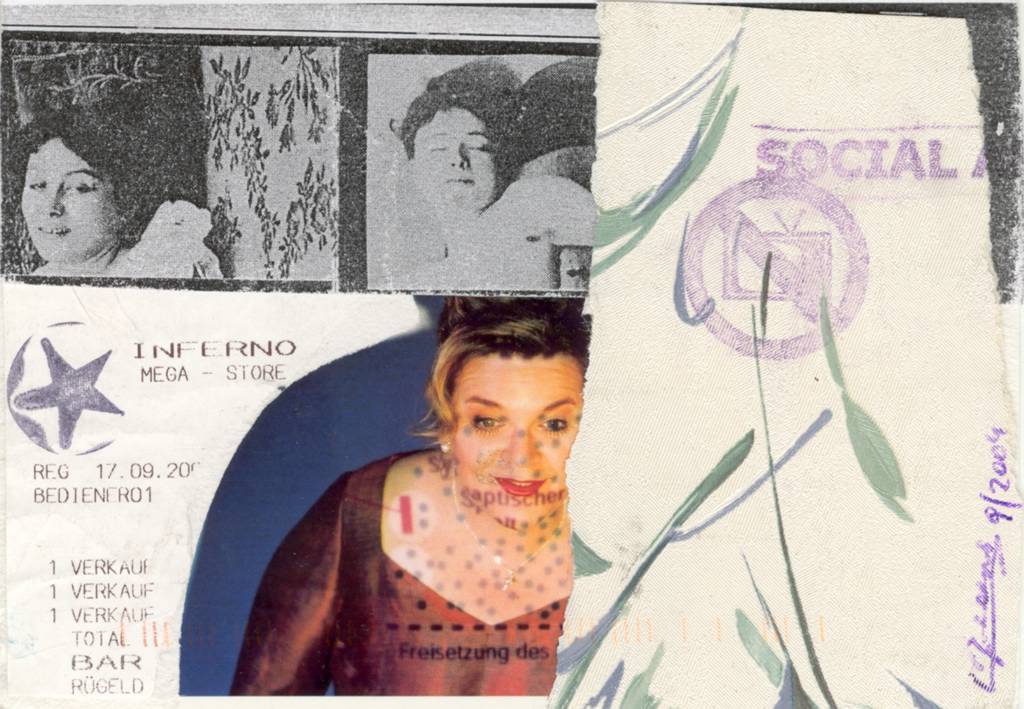
Luc Fierens has rubberstamped the address side of his recent postcard with the words "FOUND POETRY," and the rest of that side is covered with stampings and labels, images and words in the usual Fierensian style.

The obverse of the card is a multi-media collage that includes but a few words (so not exactly found poetry). The collage includes photocopied images, a cash register receipt, a color photograph, and a bit of wallpaper with a couple of purple stampings, a signature, and a date. These pieces are joined together to fill the space together. There is no attempt here to construct another visual story with these pieces. Instead, we have the Bern Porter method of collage: slivers of images and text added to the same space to suggest disorder, even chaos, to suggest the lack of suggestion.


Luc Fierens, "Social" (27 Sep 2004)

un violon d'ingres

Mail from Three Places Sent on 27 September 2004

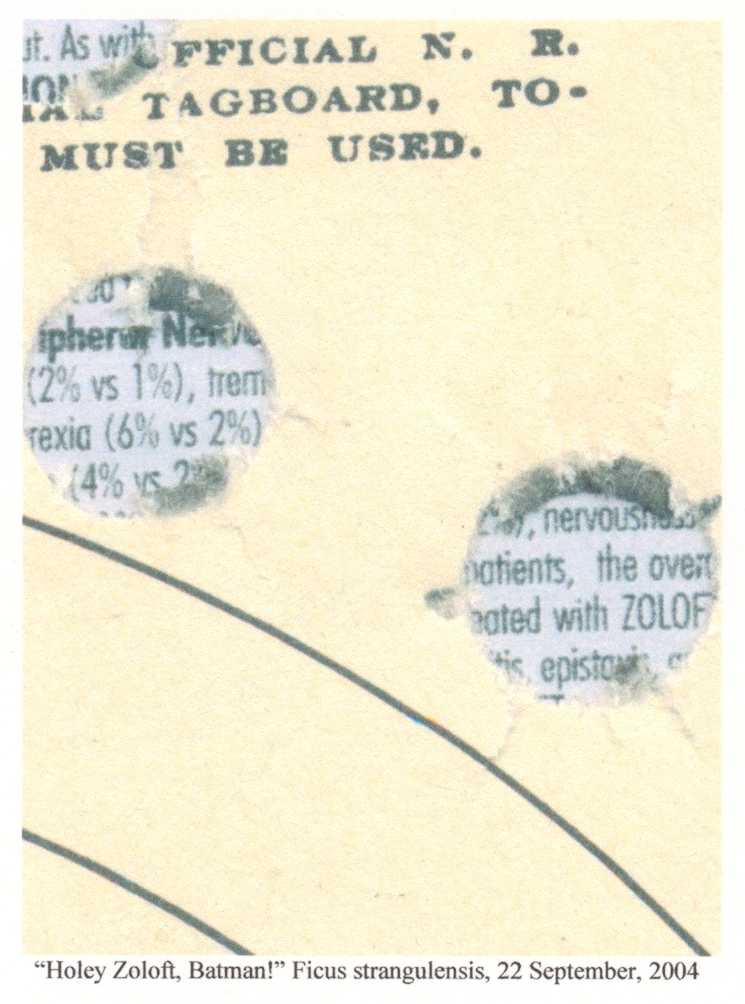
Dr. Strangulensis Continues

Last I heard, Ficus strangulensis planned to recede into temporary mailart semi-retirement to take care of his parents, so I was surprised to receive another Ficus mailing bundle. Fike always sends an envelope of pieces: a table listing recent email received and sent, a note written on the sheet with the table, bunches of little cards (two cards of textual collage, an abstract painting/postcard entitled "Slewage Doubled Spindle four"), and always a text or collage or something printed directly on the envelope (this time, "Hebephrenic detail for Ack [from R.A. Wilson's "Shrodinger's Cat"].


Ficus strangulensis, "Holy Zoloft, Batman!" (23 Sep 2004)

Arenella Pulls it All Together

Roy Arenella sends me a photocard that explains where he found the "house/tree image in 'Hurricane's Alphabet'" (which I identified as a house destroyed in the Johnstown Flood). The altered photo on the postcard somehow ties this issue together. In "Hurricane's Alphabet," Roy used a photo from a flood to represent damage from a generic disaster. Nothing wrong with that, and his card made its point well. The whole worked well, and that parts didn't have to be truly parts of a hurricane.

In this card, Roy has taken a simple photograph, crisply photographed but almost unremarkable, and he has enhanced this through an adamic process: he names the pieces in the photo. The solid black window, painted and barred, is the "WHOLE," and giant shards of something on the ground are marked "P," "A," "R," "T," and "S."

This is mailing number 408XP/C.


Roy Arenella, "Whole & Parts" (21 May 2004)


Flying Paper (Air)planes through the Mail

Scott McDonald sends a small card that successfully bonds an slip of inkjet-printed plastic (with the negative image of a paper airplane) onto a piece of card. Beautifully bonded, but all I can wonder about is the longevity of the technique!

Scott also reports that "'FATE' was a very trippy thing to find in my mailbox yesterday..."


Scott McDonald, [ghostpaperplane] (Sep 2004)

un violon d'ingres

Arenellamail and Altemuspost

Arenellamail

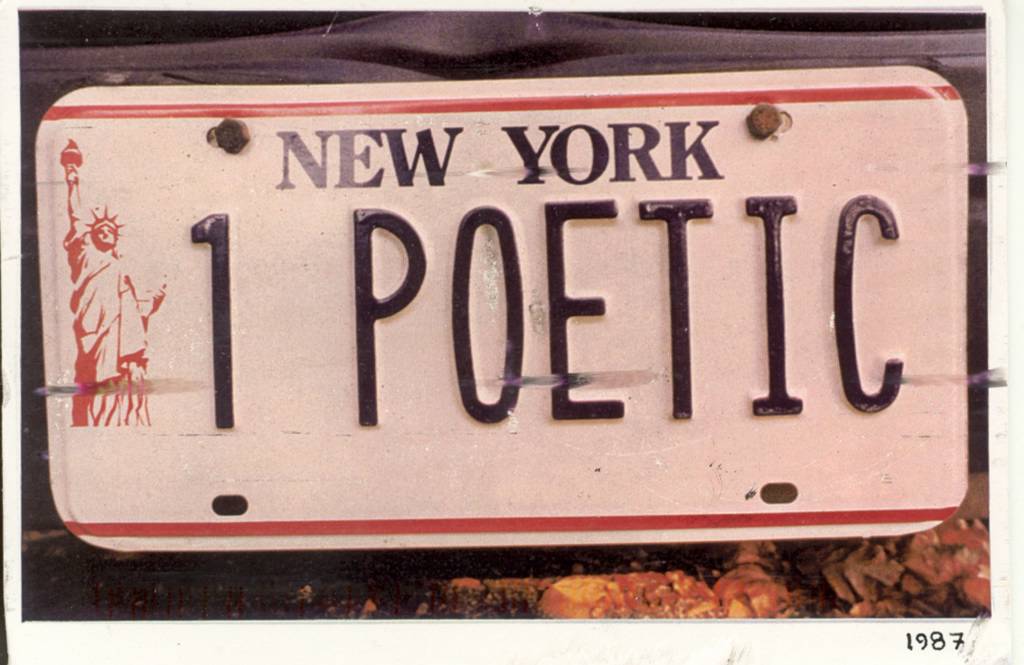
Returning to my accumulated mail, I discover that the earliest one, from almost three weeks ago, it's a photocard mailed out by Roy Arenella on September 23rd.

Roy is often a documentary visual poet, a photographer who finds texts in the wild and captures them in their native environments. The photograph on the obverse of this card is a simple capture: a license plate, from the state we share (New York), with the message "1 POETIC." On my copy, the rollers used to move this card through the mailworks left smudges on the card. These smudges suggest speed and movement, which is appropriate since Roy uses this card to tell me he's traveling with his wife (Martine) and dog (Dash) all over that part of upstate New York to the west of me.

This card is number 405 CXP/C, meaning it is the 405th mailing and also a photocard with color xeroxing. The pseudo-cancellation includes a wavy red rectangle inside of which we find the characters, "NY!" Roy is (was) traveling the state!


Roy Arenella, "1 POETIC" (1987)

Roy addressed this card to "gE(+)F UTH." The presentation of my first name, which I very much enjoy, follows a common Arenellan pattern. But the UTH without an initial H is new. There is no way that Roy could know that Uth is actually one of the forms of my surname, not necessarily a "correct" form, but it is one form that h-dropping priests, guessing a spelling, entered into sacramental registers in Alsace, France.

Altemuspost

On the same day that Roy sent me his card, Reed Altemus sent me a large envelope of mailart, decorated with colorful artists' stamps.

Inside the envelope there are, according to Reed, "Some recent and not-so-recent page works & stamps. Also some small treats of the networking variety":

The note quoted above on a Lettrism Against Fascism postcard.

Three "Typollages," rectangles filled with a beautiful collection of asemic type speciments in full paragonnage.

A copy of the zine, Unarmed, out of St. Paul, Minnesota.

An announcement for the assembling project, Floss.

Two remarkably vibrant color xerox "collage journal" pages.

A couple of sheets of photocopied text movements.

"100 Percent Recycled Mail Art Content Stampsheet No. 3"

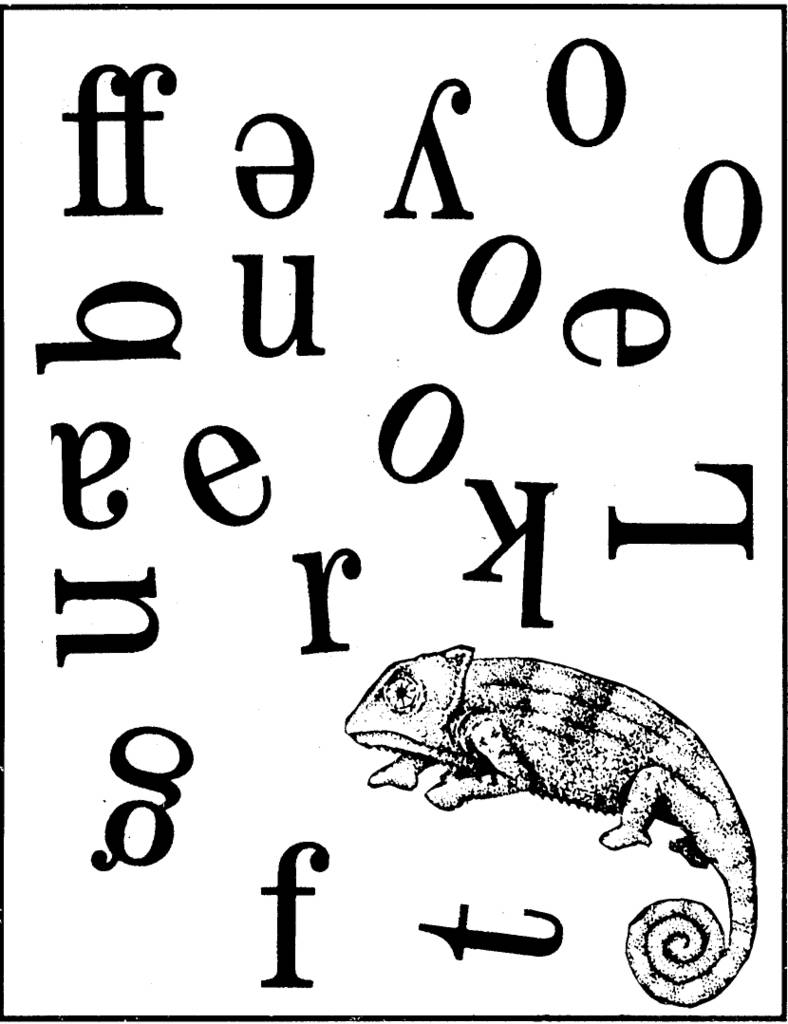
Three other visual poems (my favorite includes a chameleon surrounded by a mishmash of letters).

Weirdest of all, Reed has included a small card with the words "THANK YOU" in raised lettering, though I cannot imagine why Reed would thank me!


Reed Altemus, "ffeyo" (2004)

un violon d'ingres

Monday, October 11, 2004

MY NAME IS (qbdp # 35)

I created a simple card while still out at the lake today. I took free cards picked up in New York City last year: bright red faces (each with a separate sentence, like "Take charge / of your love life."), each advertising the ABC reality show, The Bachelor.

In this environment, I scratched out three labels, each meant to represent a name badge such as people sometimes wear at professional meetings.

The recipients of "MY NAME IS" (qbdp # 35) are the following:

1. Ruth and Marvin Sackner

2. Bob Grumman

3. Roy Arenella

4. Erin Huth

5. qbdp

Geof Huth, "MY NAME IS" (11 Oct 2004)

un violon d'ingres

Sunday, October 10, 2004

Danauzgy (qbdp # 34)

Still Point, Garlock Road, Caroga Lake, New York

I've let this "responsibility" of my life (qbdp) slip a bit over the past couple of weeks. I didn't keep up with my process of recognizing my mailart correspondents, held back too much by sickness, travel, and preparation for travel. Worst of all, I didn't even release an "issue" of qbdp on two separate nights away from home over the past week. Last Sunday, I slept on a plane, taking a redeye back east from Los Angeles, so I didn't have the energy to create a set of cards while I was flying--and what would the other passengers have thought? And two days later, I was away from home again (in Elmsford, just outside of White Plains, New York), and I was so sick and busy that night (not getting into my hotel room until about 11:30) that I gave up the idea of producing an "issue."

In the next few days, I will add illustrations to my more recent entries below and I will return to a discussion of the mail I've received over the past couple of weeks. Catching up should be interesting.

Today, I made up for my laziness regarding qbdp's by producing the most complicated one yet, a small found card decorated with a fidgetglyph and other handwriting and stored within a handlettered envelope.

The carrier for this mailing is a grey invitation envelope with a bold address in black covering most of its front. The reverse includes two return addresses: My home address on the premlip, and a partial address for this camp I'm writing from just under the premlip.

Inside, there is a found card. I had sixteen of these, so I made sixteen mailings. The card is a grey laid card printed on one side: a vinelike decoration around the edge, a logo (a boy riding a giant grasshopper jumping over a giant H that protects a smaller H between its two legs) at the top of the page, and a simple message ("Holiday House / is coming to town"). I can no longer remember where I found these cards, but they are interesting.

Under this logo and message (or emblem and verse), I wrew a small fidgetglyph called "Danauzgy," which is a simple fidgetglyph about vision and the interpretation of what we see.

The "colophon" for this issue I wrote within the openings between the entwining tendrils of the edge decoration. This colophon includes the qbdp number, the date of creation, my name (as author), and the sequential number ("1/16," etc.). I also added "UT" between the two aitches under the grasshopper--thus spelling out my name. Finally, I colored the logo in red, green, brown, and blue.

Since this is a holiday card (apparently celebrating Columbus Day), I wrapped the card in a ribbon made of a cutting of Berroco Mosaic FX yarn, which looks something like two lines of thread held together with a series of thick rungs.
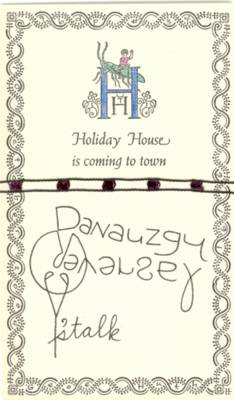

Geof Huth, "Danauzgy" (10 Oct 2004)

On the back of the card, I wrote a unique message to each of the recipients.

These are the lucky recipients of "Danauzgy" (qbdp # 34):

1. Ruth and Marvin Sackner

2. Robert Grumman

3. Roy Arenella

4. Mick Boyle

5. kiyotei

6. Ficus strangulensis

7. Scott McDonald

8. Ross Priddle

9. Reed Altemus

10. Luc Fierens

11. j0llyr0ger

12. endwar

13. Dees and Yuriko Stribling

14. Angelica Paez

15. Erin M. Huth

16. qbdp

un violon d'ingres
Saturday, October 02, 2004

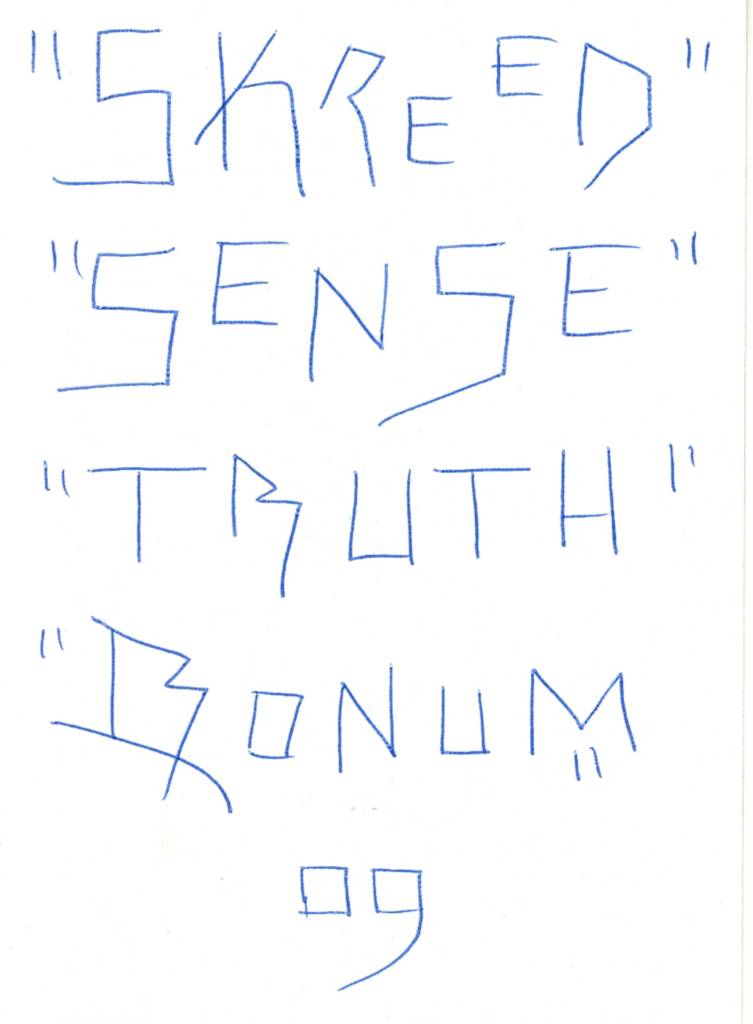
"SKREED" (qbdp # 33)

Courtyard by Marriott, Room 310, Long Beach, California

I flew across the country today, little thinking what I'd create tonight but knowing I should plan to do something for tonight. As I was waiting for a shuttle to the airport, I found a graffito carved into a pole. This small graffito (with silver letters in a brown pole) was a great bit of inspiration, and tonight's "'SKREED'" is a reworking of this found text.

The recipients of "'SKREED'" (qbdp # 31) are as follows:
1. Ruth and Marvin Sackner

2. Bob Grumman

3. Roy Arenella

4. Erin Huth

5. qbdp


Geof Huth, "SKREED" (2 Oct 2004)

un violon d'ingres

Friday, October 01, 2004

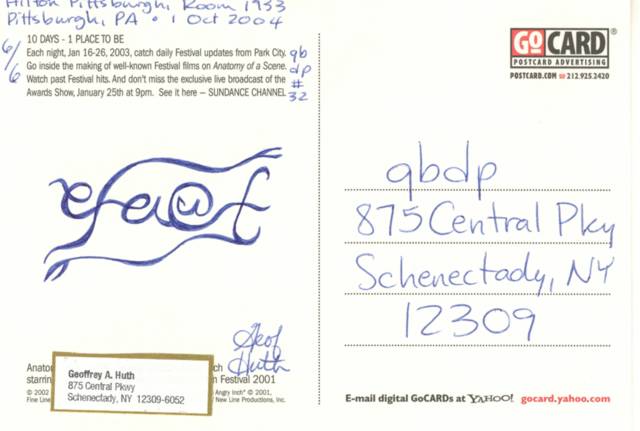
(eyg)(eau)(auo)(Eft) (qbdp # 32)

Hilton Pittsburgh, Room 1933, Pittsburgh, Pennsylvania

Today, I wrew a tiny fidgetglyph where each character represented three separate characters. To ge the right effect, I had to wraw these with a ballpoint pen.

The recipients of "(eyg)(eau)(auo)(Eft) " (qbdp # 32) are as follows:

1. Ruth and Marvin Sackner

2. Bob Grumman

3. Roy Arenella

4. kiyotei

5. Qpidoremix

6. qbdp


Geof Huth, eyg.eau.auo.Eft (1 Oct 2004)

un violon d'ingres